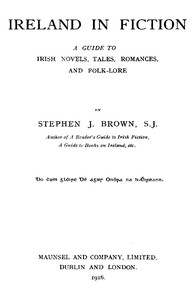
Ireland in Fiction: A Guide to Irish Novels, Tales, Romances, and Folk-lore — Themes and Context
Edition facts
Stephen J. Brown's Ireland in Fiction (1916) is a bibliographic guide that catalogs works of fiction dealing with Ireland or the Irish abroad, arranged alphabetically by author. Unlike a reading list, it aims to provide "descriptive notes of an objective nature" without recommending or condemning. The preface explicitly distinguishes this volume from Brown's earlier Reader's Guide to Irish Fiction (1910): the number of books covered is nearly doubled, the arrangement shifts from subject classification to author names, and a combined title-subject index is added. Biographical notes on many authors precede the entries for their works.
Scope and Structure
Brown defines his scope narrowly: only fiction published in volume form that deals with Ireland or the Irish abroad. This excludes works by Irish-born authors like Goldsmith if their fiction does not treat Irish subjects. The main body lists authors alphabetically, with each entry providing publication details, page counts, and descriptive notes. Four appendices offer classified lists: historical fiction, Gaelic epic and romantic literature, folklore and legend, fairy tales for children, Catholic clerical life, and humorous books. A separate appendix notes fiction in Irish periodicals. The index combines titles and subjects, a feature absent from the earlier guide.
Treatment of Individual Authors
The excerpts show Brown's method through entries on Charles Lever. For each novel, he supplies a brief plot summary, identifies notable characters, and sometimes includes authorial remarks—Lever considered The Dodd Family Abroad his best work, and Brown notes that Lever thought One of Them suitable for a stage adaptation. Brown highlights recurring character types: the "droll specimen of Yankee" Quackinboss, the fire-eating Major M'Cormack, and the audacious innkeeper Tom O'Rorke. He also points to autobiographical elements, such as Lever portraying his own son in Barrington. The notes are factual, avoiding evaluation, though they occasionally record the author's own opinion.
Reference Features and Limitations
Brown's work is a reference tool, not a critical study. Entries are concise, often under 200 words, and focus on factual details: setting, principal characters, and notable incidents. The preface stresses that the book "neither condemns nor recommends." However, the classified lists imply a thematic organization that may guide users toward certain genres. The inclusion of biographical notes adds context, but Brown does not assess literary merit. Users seeking critical analysis or reading recommendations must look elsewhere. The guide is best used to identify novels set in specific Irish locales or dealing with particular themes, such as Catholic clerical life or folklore.
Brown's Ireland in Fiction remains a valuable snapshot of Irish fiction up to 1916, documenting hundreds of works that might otherwise be forgotten. Its alphabetical arrangement and index make it practical for targeted searches, while the classified lists offer pathways into genres like historical fiction or folklore. Readers interested in the development of Irish literary culture will find this a useful starting point, though they should supplement it with modern scholarship for critical perspectives.