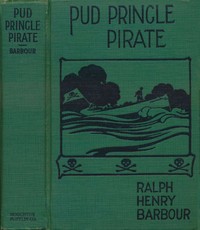
The novel opens with a grocery-store wordplay scene that immediately establishes Pud Pringle's character: he deliberately misorders 'half a pound of leese and a dozen chemons,' twisting 'cheese and lemons' to fluster the jovial grocer Mr. Ephraim Billings. This playful defiance, paired with Pud's 'deeply tanned, brown-haired, brown-eyed' appearance and 'nose that tilted inquiringly upward,' signals a boy who tests boundaries without malice. The early pages also introduce his strained friendship with Tim Daley—when asked about his 'side-partner,' Pud replies 'indifferently'—and his rivalry with the sour clerk Eg Stiles, a 'born pessimist.' These small tensions hint at larger conflicts to come.
A Fisherman's Patience and a Dog's Excitement
In a later excerpt, the narrative slows to observe a fishing scene with unusual care. Pud and Tim watch a man in a punt whose 'yellow hound' wags its tail 'deliriously' as a cork float disappears. The fisherman methodically pays out line, coils it 'between his feet as methodically and calmly as though a hard-fighting bass was not on the other end.' When a fourteen-inch bass is landed, the hound 'barking more furiously than ever, sprang upon it, his tail wagging delightedly.' The dog's unrestrained joy contrasts with the man's quiet control—a dynamic that echoes Pud's own impulsive nature against adult composure. The passage also shows Pud's eagerness to learn: he immediately adjusts his own rig to match the neighbor's setup, moving his lead 'four feet short of the hook.'
The Thrill of the Strike
The fishing episode builds to Pud's own strike. When his bob 'acted queerly' and then 'started away as though having business at the other side of the lake,' Pud's hands tremble. Tim scolds him for not striking, but the fish returns, and then 'a bronze-and-silver flash in the water' triggers a frantic battle. Pud loses his line, gropes 'wildly,' and finally catches it 'when it caught about his foot.' The reel clicks and spins: 'Click-click-click —Then cli-i-ick! and out spun the line again!' The dialogue is breathless: 'Gee, he must be a whale!' panted Pud. Tim hops about, sputtering advice. This scene captures the physical excitement of the chase—the lost line, the tangled foot, the shouted instructions—and foreshadows the larger adventures where quick thinking and teamwork will matter.
From Riverbank to Pirate Flag
The chapter titles trace a clear arc from everyday troubles to full-blown pirate play. Early chapters like 'Mr. Tully Misunderstands' and 'Friends Make Up' suggest misunderstandings and reconciliations, while 'The Kismet Starts on her Voyage' introduces the motorboat that becomes the boys' vessel. By Chapter IV, 'Under the Skull-and-Cross-Bones,' the pirate identity is explicit. Later titles—'The Prisoner in the Tower,' 'The Rescue,' 'Pursuit,' 'Fish-Hawk Creek,' 'Set Adrift,' 'Marooned!'—promise a series of escalating crises. The catalog subjects (motorboats, rivers, friendship) ground these adventures in real-world settings, but the chapter headings hint at melodramatic turns: counterfeit money, a deserted cabin, a character named Tally Moore who 'Talks.' The excerpts do not reveal how these elements connect, but the progression suggests a gradual transformation from ordinary river trips to staged pirate scenarios that may become genuinely dangerous.
Voice and Vernacular
Barbour's dialogue is peppered with period colloquialisms and playful banter. The grocer exclaims 'Consarn you!' and 'pesky well'; Pud retorts with deliberate mispronunciations. Tim uses 'Pshaw' and 'the ticket.' The narrative voice is lightly omniscient, occasionally winking at the reader—'If Pud could have barked, he would probably have joined in with the dog!'—and fond of compound adjectives like 'sour-looking' and 'bronze-and-silver.' Physical descriptions are brisk and vivid: Eg Stiles is 'tall, thin, sour-looking'; Mr. Billings is 'large, red-faced, and jovial.' The prose favors action over introspection, with short paragraphs and frequent exclamations. This brisk, conversational style suits the episodic plot and keeps the focus on external events rather than internal conflict.
Readers approaching Pud Pringle, Pirate for the first time will find that the excerpts reward attention to small details: the way a fishing scene builds tension, the precise language of a grocery order, the gradual shift from river realism to pirate fantasy. The novel's 24 chapters promise a brisk, eventful journey. Pay particular attention to how the boys' friendship is tested—the early quarrel mentioned in Chapter I may echo in later crises. And watch for the yellow hound: his appearances may signal more than comic relief.
Reading Pud Pringle, pirate, I kept thinking how those river afternoons feel a little like riding out on the range—not the adventure, but the quiet way boys fill the hours with small, serious tasks. That same patient warmth turned up in The X Bar X boys at the round-up — Story, Setting & Ideas, and I found myself smiling at the familiarity.