About 798 minutes
History of English Literature Volume 3 (of 3) — Key Ideas to Explore
Science Fiction Utopias
183,537 recorded words. 19 minutes difference from this book's estimate.
View Gutenberg source #61510
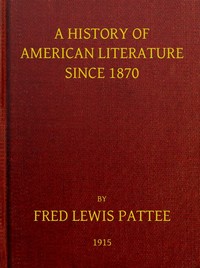
This digital edition of A History of American Literature Since 1870 — Story, Setting & Ideas is described by source-level measurements including 179,061 words, 12 hr 59 min estimated reading time, and 23 detected text sections.
The text analysis averages about 21.4 words per sentence, while the detected sections provide another way to judge how the source is divided.
Project Gutenberg metadata also associates the work with “American literature -- 19th century -- History and criticism,” connecting these edition facts with the source record’s subject description.
Explore this collection
These alternatives are selected using recorded categories and estimated reading time.
About 798 minutes
Science Fiction Utopias
183,537 recorded words. 19 minutes difference from this book's estimate.
View Gutenberg source #61510About 740 minutes
Science Fiction Utopias
170,099 recorded words. 39 minutes difference from this book's estimate.
View Gutenberg source #10631About 722 minutes
Science Fiction Utopias
165,974 recorded words. 57 minutes difference from this book's estimate.
View Gutenberg source #31132Search stored excerpts and compare books → Choose by your preferences →
Choices use stored catalog measurements. Estimates vary with reading speed. A shared category is a catalog label, not a claim that two books have the same argument or literary quality.
Search reads excerpt text stored with this catalog and links to its associated Gutenberg record. The connection is stored in the site database; this tool does not recheck that every excerpt is word-for-word identical to that external record. Excerpt search does not cover every chapter and does not verify historical publication dates.
Catalog snapshot checked: 2026-09-25. Coverage: 98 public books, 98 available source excerpts.
Calculated from edition completeness, EPUB availability, text structure and catalogue metadata. Not a user rating.
Total of 100 points, scaled to a 2.5-5.0 range. Editions with an empty description or a missing EPUB file are not scored.
Public-domain source text
The source text is kept in the dedicated reader, separate from this catalogue record and its commentary.
Pattee opens his preface by declaring that American literature 'in the larger sense of the term began with Irving,' then immediately unsettles any fixed periodization. He notes that the 'Central Period' (Emerson's era) has no official closing, yet all its forces have 'expended themselves.' This structural framing—a history that begins by questioning its own boundaries—recurs throughout the book. Pattee organizes his chapters around individual authors, but his deeper argument emerges from repeated images of movement: the 'westward exodus,' the 'ebb' of New England, and the 'passing of an old régime.' These are not mere metaphors; they shape his critical judgments about which writers matter and why.
Pattee’s preface establishes a central structural tension: literary periods do not end cleanly. He writes that the 'Victorian Era in England' and the 'Age of Emerson' in America have 'no official closing,' yet he insists that a 'distinctively new period has not only begun but has already quite' arrived. This self-consciousness about periodization runs through the book. Pattee does not simply list authors chronologically; he groups them to highlight transitions. For instance, he contrasts Mrs. Stowe and Mrs. Cooke as depicters of 'New England at flood tide' with Sarah Orne Jewett, who painted 'the ebb.' The image of tidal movement—flood and ebb—gives the literary history a rhythmic structure, where each generation responds to a cultural tide that is already receding.
Pattee’s analysis of Jewett’s work reveals a recurring motif: the summer boarder as a disruptive figure. He quotes Jewett’s autobiographical fragment, where she recalls how 'the first city boarders' misconstrued country people, and she resolved to 'teach the world that country people were not the awkward, ignorant set.' This anecdote becomes a lens for Pattee’s broader argument about regional literature. He identifies a pattern in post-1870 fiction: the 'deserted farm,' the 'decaying seaside town,' and the 'pathetic return of the native for a brief day.' These are not just settings; they are structural devices that allow writers to contrast old and new, rural and urban, stability and flux. Pattee’s own prose mirrors this movement, shifting between close reading of Jewett’s style and wider claims about New England’s social transformation.
Pattee devotes considerable space to situating Jewett within a literary geography. He calls her 'little stretch of Maine coast with its pointed firs, its bleak farms, and its little villages redolent of the sea' her 'peculiarly own domain,' comparing it to Hardy’s Wessex and the fictional Cranford. But he is careful to mark boundaries. He compares Jewett to Hawthorne, then immediately pulls back: 'Of his power to trace the blighting and transforming effects of a sin and his wizard knowledge of the human heart, she had nothing.' This move—asserting a comparison only to qualify it—is typical of Pattee’s method. He uses contrast to define literary territory, not to rank. His observation that Jewett’s kinship is with Howells rather than Hawthorne, based on 'lambent humor' and 'exquisite art,' shows how he builds critical judgments from specific stylistic traits.
Pattee’s chapters follow a consistent internal structure: a biographical opening, a survey of major works, and a critical assessment that often returns to a single image or phrase. In the Jewett section, he moves from her early publication ('Mr. Bruce' in the Atlantic, 1869) to her stated mission, then to a series of comparisons that refine her place. The prose itself enacts the 'ebb' he describes—long, flowing sentences about Jewett’s 'serenity and seriousness' give way to shorter, sharper judgments: 'She is a writer of little books and short stories.' This rhythm is not accidental. Pattee’s own style mirrors the literary transitions he analyzes, making the book’s form part of its argument. Readers attentive to his sentence structures will find a history that performs the very movements it describes.
Pattee’s history rewards readers who attend to its recurring images—tides, exoduses, and decaying wharves—as much as its author-by-author summaries. The book is less a neutral record than a critical performance, one that uses structure and metaphor to argue for a particular literary lineage. For those interested in how literary histories construct their own authority, Pattee’s preface and his Jewett chapter offer a revealing case study in the rhetoric of periodization.
I keep thinking about Pattee’s old book, how transitions feel less like endings and more like quiet drift. There’s a strange comfort in watching one culture’s ebb give way to another. That same gentle movement surfaces in The Influence of Old Norse Literature on English Literature — Edition Insights, where old voices shape newer ones without ever really vanishing. It lingered with me like a half-remembered shore.
Answer a few questions and save a private reflection on this device.