About 798 minutes
History of English Literature Volume 3 (of 3) — Key Ideas to Explore
Science Fiction Utopias
183,537 recorded words. 272 minutes difference from this book's estimate.
View Gutenberg source #61510
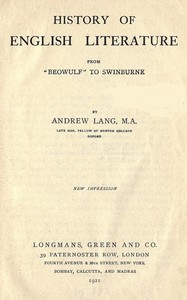
For History of English Literature from "Beowulf" to Swinburne — Background and Themes, the stored edition analysis reports 246,018 words, 17 hr 50 min estimated reading time, and 30 detected text sections.
The text analysis averages about 21.4 words per sentence, while the detected sections provide another way to judge how the source is divided.
Project Gutenberg metadata also associates the work with “English literature -- History and criticism,” connecting these edition facts with the source record’s subject description.
Explore this collection
These alternatives are selected using recorded categories and estimated reading time.
About 798 minutes
Science Fiction Utopias
183,537 recorded words. 272 minutes difference from this book's estimate.
View Gutenberg source #61510About 779 minutes
Science Fiction Utopias
179,061 recorded words. 291 minutes difference from this book's estimate.
View Gutenberg source #42593About 740 minutes
Science Fiction Utopias
170,099 recorded words. 330 minutes difference from this book's estimate.
View Gutenberg source #10631Search stored excerpts and compare books → Choose by your preferences →
Choices use stored catalog measurements. Estimates vary with reading speed. A shared category is a catalog label, not a claim that two books have the same argument or literary quality.
Search reads excerpt text stored with this catalog and links to its associated Gutenberg record. The connection is stored in the site database; this tool does not recheck that every excerpt is word-for-word identical to that external record. Excerpt search does not cover every chapter and does not verify historical publication dates.
Catalog snapshot checked: 2026-09-25. Coverage: 98 public books, 98 available source excerpts.
Calculated from edition completeness, EPUB availability, text structure and catalogue metadata. Not a user rating.
Total of 100 points, scaled to a 2.5-5.0 range. Editions with an empty description or a missing EPUB file are not scored.
Public-domain source text
The source text is kept in the dedicated reader, separate from this catalogue record and its commentary.
Andrew Lang opens his History of English Literature from 'Beowulf' to Swinburne with a frank admission of the difficulty of covering so vast a subject. He declares that the volume 'does not pretend to be an encyclopædia' and that selection has been necessary, especially in philosophy and theology. His stated aim is 'to arouse a living interest' in older books, urging readers to turn to the originals rather than to secondary works. This preface sets the tone for a personal, opinionated survey rather than a neutral reference work.
Lang's treatment of John Milton reveals his willingness to offer sharp personal judgments. He writes that Milton 'was not vain with the childlike vanity of some poets, but he was as proud as his own Satan.' Lang contrasts Milton with Shakespeare and Scott, who 'never gave a thought to their genius,' implying a preference for authors who seem less self-conscious about their abilities. He also notes Milton's lack of humour, stating that 'like Wordsworth and Shelley he was devoid of humour,—and thus fails … to win universal sympathy.' These remarks go beyond summary into character assessment, showing Lang's method of blending literary analysis with biographical commentary.
The excerpts show that Lang devotes substantial space to major figures like Milton while acknowledging the difficulty of covering minor authors. He writes that each master 'springs from an underwood … of the thought and effort of men less conspicuous, whom it were ungrateful … to pass by in silence.' Yet he admits that he would have preferred to omit many minor authors and focus only on the masters. This tension between comprehensiveness and selectivity shapes the book's structure. The table of contents reveals a chronological arrangement from Anglo-Saxon literature through to Swinburne, with chapters on periods and genres rather than individual authors alone.
Lang enriches his narrative with personal reflections and literary allusions. For instance, he remarks on 'a college friendship between two boyish poets, and no later friendships can be so tender, close, dear; the lost voice ever echoing in the memory.' This appears in his discussion of Milton's Lycidas. He also references Matthew Arnold's 'Thyrsis' as an Oxford pendant to the Cambridge lament. Lang's style is conversational and allusive, assuming a reader familiar with a wide range of literature. He does not hesitate to express his own tastes, as when he calls Milton's sonnet on the Piedmont massacre 'good' while noting that Milton did not mourn for the massacres at Drogheda and Dundee.
Readers approaching Lang's history should expect a personal tour rather than an exhaustive catalog. His judgments are often provocative, and his selection of authors reflects his own preferences. The book is best used as a companion to the primary texts he discusses, especially for those interested in late Victorian critical perspectives. Lang's allusions to other works and his occasional digressions reward a reader already familiar with the literary landscape he surveys.
I kept thinking of Lang’s firm, personal verdicts on Milton while turning pages in Fables — Story, Setting & Ideas. There’s something in how he picks apart a tale’s bones—not to condemn, but to see what holds. It felt like the same unhurried hand, generous with its judgments, leaving me to sit quietly with my own.
Save your reaction, strongest insight, and memorable passage.