About 66 minutes
The art of fiction — Reading Companion
Science Fiction Utopias
14,989 recorded words. 31 minutes difference from this book's estimate.
View Gutenberg source #76460
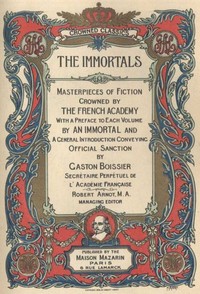
The catalog record for The Immortals: Masterpieces of Fiction, Crowned by the French Academy — Complete — Story, Setting & Ideas provides practical reading context through 7,959 words, 35 min estimated reading time, and 3 detected text sections.
The text analysis averages about 11.5 words per sentence, while the detected sections provide another way to judge how the source is divided.
Project Gutenberg metadata also associates the work with “Literature -- Collections,” connecting these edition facts with the source record’s subject description.
Explore this collection
These alternatives are selected using recorded categories and estimated reading time.
About 66 minutes
Science Fiction Utopias
14,989 recorded words. 31 minutes difference from this book's estimate.
View Gutenberg source #76460About 78 minutes
Science Fiction Utopias
17,759 recorded words. 43 minutes difference from this book's estimate.
View Gutenberg source #343About 139 minutes
Science Fiction Utopias
31,936 recorded words. 104 minutes difference from this book's estimate.
View Gutenberg source #3377Search stored excerpts and compare books → Choose by your preferences →
Choices use stored catalog measurements. Estimates vary with reading speed. A shared category is a catalog label, not a claim that two books have the same argument or literary quality.
Search reads excerpt text stored with this catalog and links to its associated Gutenberg record. The connection is stored in the site database; this tool does not recheck that every excerpt is word-for-word identical to that external record. Excerpt search does not cover every chapter and does not verify historical publication dates.
Catalog snapshot checked: 2026-09-25. Coverage: 98 public books, 98 available source excerpts.
Calculated from edition completeness, EPUB availability, text structure and catalogue metadata. Not a user rating.
Total of 100 points, scaled to a 2.5-5.0 range. Editions with an empty description or a missing EPUB file are not scored.
Public-domain source text
The source text is kept in the dedicated reader, separate from this catalogue record and its commentary.
The volume opens not with a story but with a sustained argument by Gaston Boissier, Secretary of the French Academy, who contends that novels offer a truer picture of French private life than plays do. He writes that the theatre presents types, not individuals, and that its audience is “impatient of the least delay,” whereas a novel’s reader can pause and reflect. This preface directly shapes how the twenty-one works that follow should be approached: as deliberate, detailed portraits of society rather than as swift entertainments.
Boissier’s claim that the novelist “can add without restraint every detail that seems needful” alerts a first reader to watch for descriptive density and psychological nuance. The table of contents, listing titles such as Serge Panine, The Red Lily, and Madame Chrysanthème, signals a range of settings—from Parisian drawing rooms to colonial Japan—but all are united by the Academy’s stamp and by Boissier’s insistence on verisimilitude.
The general introduction, written in the first person, repeatedly contrasts the stage with the page. Boissier states that “the exact and studied portrayal of a character demands from the author long preparation” and cannot be accomplished in a few hours. This is a direct invitation to read each novel slowly, attending to how characters are built through accumulated detail rather than through dramatic shortcuts. He also notes that French homes are “rarely open to birds of passage,” positioning the collection as a surrogate for the intimate knowledge a traveler cannot gain. For a first reader, this preface functions as a contract: the works inside are meant to reveal the “inner home life” of France, and the reader is expected to bring patience and curiosity.
The index lists twenty-one titles, each with a named author and a chapter breakdown. The earliest chapters of Serge Panine include headings like “The House of Desvarennes” and “The Galley-Slave of Pleasure,” suggesting a focus on family and moral conflict. The Red Lily opens with “I Need Love” and “One Can See That You Are Young!”, pointing toward romantic and psychological drama. Other titles, such as An “Attic” Philosopher and The Ink Stain, hint at domestic or comic registers. This variety means a reader can choose an entry point based on mood, but Boissier’s preface implies that all share a commitment to individualized, unhurried characterization. The presence of multiple books within each novel—for instance, Serge Panine has four books—indicates that these are substantial works, not brief tales.
Although the excerpt is mostly paratext, Boissier’s own prose demonstrates the method he advocates. He builds his argument step by step, addressing the reader directly (“I ask myself again”) and using qualifying phrases such as “often, too” and “again.” This careful, additive style mirrors what he praises in novelists: the freedom to “return at will” to a point and to “emphasize and dwell.” A first reader can test Boissier’s theory by sampling any of the listed novels—for example, Fromont and Risler by Alphonse Daudet or Conscience by Hector Malot—and observing whether the characters indeed feel like individuals rather than types. The excerpt does not include story text, so the reader must rely on the preface’s promises and the chapter titles to form expectations.
The volume is presented as “Complete,” meaning all twenty-one novels are included in one file. The table of contents is interactive, with links to each work’s index. This design encourages non-linear reading: one might start with a familiar name like Anatole France or Pierre Loti, or jump to a shorter work such as The Abbé Constantin by Ludovic Halévy. Because the preface argues that novels require leisure, a first reader might plan to read one work at a sitting, treating each as a self-contained unit. The chapter titles often hint at turning points—“Confession,” “The Crisis,” “The Mother’s Revenge”—which can help a reader gauge pacing. The collection’s origin (French Academy prizewinners) and Boissier’s framing suggest that these novels reward attention to social detail and moral complexity rather than fast plotting.
Boissier’s preface is the key to this collection: it tells you what to look for and why. As you read, compare his claims about the novel’s superiority to the theatre with your own experience of the stories. Notice whether the characters feel like individuals, whether the settings convey private life, and whether the authors take the time to “lay bare the complications of motive.” The table of contents is your best tool for choosing a path; the preface is your guide for what to value along the way.
There's something touching about how the French Academy once gathered these novels, as if preserving a certain idea of what a story should hold. I thought of that while thumbing through The Minute Boys of Philadelphia — Background and Themes — not a grand prize winner, just a quiet chronicle of young courage. The Academy's choices feel formal, distant. That pamphlet feels like an old friend’s handwriting, and I’m oddly glad for both.
Create a short personal record of your experience with this book.