
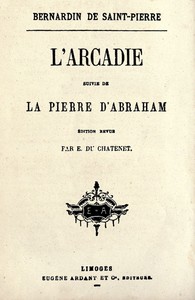
L'Arcadie; suivie de La pierre d'Abraham by Bernardin de Saint-Pierre
Let's crack open this 18th-century time capsule. Bernardin de Saint-Pierre was a contemporary of Rousseau, and you can feel that influence all over these pages. He's less concerned with plot twists and more with painting a vivid picture of an idea and then watching his characters navigate it.
The Story
In L'Arcadie, we follow Paul, a young man who discovers a secret, utopian society hidden in a remote valley. The Arcadians live in perfect peace, sharing everything and living off the land. There's no money, no government, no real strife. Paul is welcomed in and shown their ways. The "conflict" here is internal and philosophical. The story is a tour of this ideal world, and the central tension is whether Paul will choose to stay forever or return to the flawed society he came from.
La Pierre d'Abraham is a stark contrast. It's a short, potent tale about two brothers, Jacob and Esau (yes, those names are very intentional). Their father is dying, and his final wish involves a simple stone marking a well—the "pierre d'Abraham." This stone becomes the focus of a bitter feud. It's not about the object's value, but what it represents: honor, birthright, and memory. The drama unfolds in harsh, sparse landscapes, making every word and gesture feel heavy with meaning.
Why You Should Read It
I'll be honest, this isn't a fast-paced page-turner. But it's a deeply thoughtful one. Reading these stories feels like having a conversation with a very intelligent, slightly melancholic friend from the past. L'Arcadie asks if true happiness means removing ourselves from complexity. Is paradise boring? La Pierre d'Abraham shows how that complexity—family, pride, history—is inescapable and defines us.
Saint-Pierre's prose, in translation, is clear and often beautiful, especially when describing nature. He makes you feel the lush grass of Arcadia and the dry heat of the desert. The characters are more like archetypes or ideas given human form, which makes their dilemmas universal.
Final Verdict
This book is perfect for readers who love classic literature, philosophy, or quiet historical fiction. If you enjoyed the moral questions in Voltaire's Candide or the pastoral dreams in older poetry, you'll find a friend here. It's also a great, digestible way to step into 18th-century French thought. Don't go in expecting a thriller. Go in expecting to ponder, to picture these vivid worlds, and to be surprised by how relevant a 250-year-old debate about simplicity versus inheritance can feel.
This is a copyright-free edition. Share knowledge freely with the world.
Joseph Garcia
1 year agoThought-provoking and well-organized content.
Thomas Martinez
11 months agoUnlike many other resources I've purchased before, the step-by-step breakdown of the methodology is extremely helpful for students. This adds significant depth to my understanding of the field.
George Wilson
5 months agoLooking at the bibliography alone, the critical analysis of current industry standards is very timely. A mandatory read for anyone in this industry.
Sarah Lopez
2 years agoGiven the current trends in this field, the transition between theoretical knowledge and practical application is seamless. It’s hard to find this much value in a single source these days.


Susan Martin
10 months agoBefore I started my latest project, I read this and the nuanced approach to the central theme was better than I expected. A trustworthy resource that I'll keep in my digital library.