
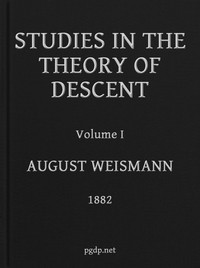
Studies in the Theory of Descent, Volume I by August Weismann
Let's be clear from the start: this isn't a novel. There's no protagonist in the traditional sense, unless you count August Weismann's relentless curiosity. The 'plot' is the dismantling of a scientific idea. In the late 1800s, many biologists believed in the inheritance of acquired characteristics—the idea that an organism's experiences could directly alter its offspring. Weismann set out to test this, not with grand philosophy, but with meticulous observation.
The Story
Weismann takes us on a tour of the natural world, focusing on detailed case studies. He spends pages on the metamorphosis of butterflies, the life cycles of tiny Daphnia water fleas, and the reproduction of hydroids. In each case, he asks: do the changes an individual goes through in response to its environment show up in its children? His answer, after exhaustive examination, is a resounding 'no.' He shows that even when an animal undergoes dramatic transformation, its reproductive cells remain isolated and protected. The famous 'Weismann's Barrier'—the concept that information flows from germ cells to body cells, but not the other way—is argued here. The story's climax is his logical conclusion: inheritance must be based on something stable and internal, passed down through these germ cells, not on the fleeting experiences of the body.
Why You Should Read It
You should read it to feel the electricity of a paradigm shifting. It's not easy; the descriptions are dense. But there's a fierce, logical beauty in watching Weismann corner a flawed idea. You see the birth of modern genetic thought before DNA was even a concept. His insistence on evidence over appealing stories is a powerful lesson in how science should work. It’s also humbling—it makes you realize how many 'obvious' ideas in history were just plain wrong.
Final Verdict
This book is perfect for readers who love the history of ideas, popular science fans who want to go back to the source, or anyone curious about how we figured out the rules of heredity. It's not a light read, but it's a profoundly rewarding one. Think of it as visiting the construction site of a major intellectual monument. You'll come away with a deep appreciation for the rigor that built our understanding of life itself.
The copyright for this book has expired, making it public property. You do not need permission to reproduce this work.
Thomas Jones
2 months agoMy first impression was quite positive because the author doesn't just scratch the surface but goes into meaningful detail. I feel much more confident in my knowledge after finishing this.
Margaret Harris
1 year agoI have to admit, it manages to explain difficult concepts in plain English. One of the best books I've read this year.
Amanda Torres
1 year agoFast paced, good book.
Dorothy Harris
2 years agoIf you enjoy this genre, the content flows smoothly from one chapter to the next. Definitely a 5-star read.
Elizabeth Thompson
10 months agoThis is an essential addition to any academic digital library.