
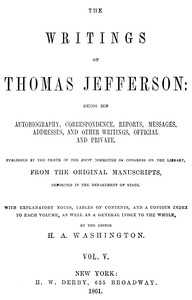
The Writings of Thomas Jefferson, Vol. 5 (of 9) by Thomas Jefferson
This isn't a novel with a plot in the traditional sense. The Writings of Thomas Jefferson, Volume 5 is a curated collection of his letters, official papers, and notes from a critical four-year window. It begins as Jefferson is serving as Minister to France, sending home vivid descriptions of the brewing revolution there. He then returns to America to become the first Secretary of State under President George Washington.
The Story
The 'story' is the birth of the American government. You follow Jefferson's pen as he navigates intense political fights. A huge part of this volume is his growing disagreement with Alexander Hamilton, the Secretary of the Treasury. Jefferson believed in a decentralized, agrarian-focused America with a weak central bank. Hamilton fought for a strong financial system and federal power. Their clash, played out in memos to Washington and letters to allies, defines the era. You also see his personal side: letters about his family, his farm at Monticello, and his deep passion for science and architecture.
Why You Should Read It
I found this volume fascinating because it strips away the marble statue and shows the man. You see his brilliance in arguing principles, but also his contradictions and worries. Reading his private letters to James Madison, you feel the urgency and anxiety of trying to get the new nation right. It makes history feel immediate. This isn't about dry policies; it's about people with strong beliefs figuring it out as they went along. You understand that the political divisions we see today have roots right here in these founding arguments about the role of government.
Final Verdict
This is perfect for anyone who loves American history and wants to go beyond the textbook highlights. It's for the reader who enjoys primary sources and doesn't mind that the narrative is built through correspondence. If you've read biographies about the founders, this is the essential raw material. It's not a light read—you have to be willing to sit with the dense political thought of the time—but the reward is feeling like you have a direct line to the room where it happened. Skip it if you're looking for a straightforward story, but dive in if you want to witness the founding debates unfold in real time.
There are no legal restrictions on this material. Access is open to everyone around the world.
Charles Smith
1 year agoGreat reference material for my coursework.
Steven Robinson
2 years agoI didn't expect much, but the depth of research presented here is truly commendable. Thanks for sharing this review.



Andrew Wilson
6 months agoVery helpful, thanks.