About 33 minutes
He — Context and Discussion
Historical Psychological Social Fiction
7,418 recorded words. 19 minutes difference from this book's estimate.
View Gutenberg source #68547
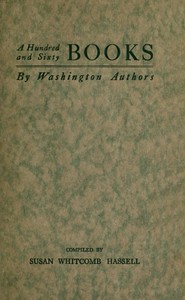
The catalog record for A Hundred and Sixty Books by Washington Authors Some Other Writers Who are Contributors to Periodical Literature; Lines Worth Knowing by Heart — Reading Notes provides practical reading context through 11,900 words, 52 min estimated reading time, and 2 detected text sections.
The text analysis averages about 13.5 words per sentence, while the detected sections provide another way to judge how the source is divided.
Project Gutenberg metadata also associates the work with “Washington (State) -- In literature -- Bibliography,” connecting these edition facts with the source record’s subject description.
Explore this collection
These alternatives are selected using recorded categories and estimated reading time.
About 33 minutes
Historical Psychological Social Fiction
7,418 recorded words. 19 minutes difference from this book's estimate.
View Gutenberg source #68547About 30 minutes
Historical Psychological Social Fiction
6,724 recorded words. 22 minutes difference from this book's estimate.
View Gutenberg source #3380About 79 minutes
Historical Psychological Social Fiction
17,962 recorded words. 27 minutes difference from this book's estimate.
View Gutenberg source #51015Search stored excerpts and compare books → Choose by your preferences →
Choices use stored catalog measurements. Estimates vary with reading speed. A shared category is a catalog label, not a claim that two books have the same argument or literary quality.
Search reads excerpt text stored with this catalog and links to its associated Gutenberg record. The connection is stored in the site database; this tool does not recheck that every excerpt is word-for-word identical to that external record. Excerpt search does not cover every chapter and does not verify historical publication dates.
Catalog snapshot checked: 2026-09-25. Coverage: 98 public books, 98 available source excerpts.
Calculated from edition completeness, EPUB availability, text structure and catalogue metadata. Not a user rating.
Total of 100 points, scaled to a 2.5-5.0 range. Editions with an empty description or a missing EPUB file are not scored.
Public-domain source text
The source text is kept in the dedicated reader, separate from this catalogue record and its commentary.
Susan Whitcomb Hassell's 1916 bibliography opens with a confident claim: Washington's literature is strongest in local lines, especially early history and personal adventure. The foreword insists that diaries, letters, and memoirs from settlers are valuable documents, and that the state's natural wonders—mountains, forests, inland seas—have inspired a score of writers. Hassell positions her list as a corrective to neglect, hoping to foster wider acquaintance among those following the same undying art.
The book is structured in three parts: the main annotated bibliography of 160 books, a shorter section on other writers who contribute to periodicals, and a closing collection of quotable lines. The annotations vary in length and tone, from brisk catalog entries to mini-narratives that reveal Hassell's own judgments and sympathies.
Hassell does not merely list titles; she evaluates. Of William Witherspoon Woodbridge's That Something, she notes its progressive mental science and adds: 'The writer believes in himself. What is rarer, he is teaching other people to believe in themselves.' She then reports sales figures—every state but three—and calls it the largest sale of any book published west of Chicago. But her praise is not indiscriminate. Of Woodbridge's earlier Skooting Skyward, she dismisses its 'atrocious Josh Billings spelling which should have been buried with its originator.'
This bluntness appears elsewhere. She describes Kenneth C. Beaton's Ye Towne Gossip as 'sparkling' and quotes a friend who calls Beaton 'a temperamental freak' for being an emotional Britisher unashamed of his emotions. The annotations mix factual description with personal reaction, giving the bibliography the feel of a conversation with a well-read, opinionated guide.
One of the longest annotations is for Annette Fitch-Brewer's Story of a Mother-love (1913). Hassell recounts the plot in detail: a divorced mother fights for custody, flees with her child, evades detectives for five years, is finally caught, and writes the book in loneliness. The summary is vivid—'the law took the boy from his mother'—and ends by calling the author 'a bright observer who wandered thousands of miles with all her senses on the alert.'
This entry stands out for its length and emotional weight. Hassell does not critique the book's style; she lets the story speak. The annotation functions almost as a miniature true-crime narrative, suggesting that for Hassell, the human interest of a book's backstory could be as compelling as its literary merit.
The section 'Other Writers' extends the bibliography beyond book authors to those who have gained distinction through periodical work. Hassell names staff writers from the Post-Intelligencer—Tom Dillon, Joseph Blethen, Jack Bechdolt—and describes their achievements: Dillon's Mother's Day prayer read into the Congressional Record, Blethen's opera libretto, Bechdolt's move to the Kansas City Star. She also notes Bernice E. Newell, whose poem 'The Mountain' was bound as the first book published in Tacoma.
This section broadens the definition of literary production, acknowledging that many writers contribute to the state's culture without publishing a book. Hassell's inclusion of periodical writers reflects her interest in the living literary scene of 1916, not just a retrospective canon.
Hassell's bibliography is best read as a period document: it reveals what one informed compiler valued in Washington literature a century ago. Readers interested in regional literary history, early twentieth-century book culture, or the rhetoric of boosterism will find it a compact primary source. The annotations reward browsing—they are uneven, opinionated, and occasionally startling in their directness.
That old bibliography feels like leafing through someone’s careful marginalia—160 quiet proofs that a place can hold a library of its own. It lingers, the way a favorite line does. I think of Scott’s own critical voice, patient and exacting, in Sir Walter Scott as a Critic of Literature — Inside the Classic, how he, too, sorted what lasts from what merely fades. Strange comfort in that.
Build a private reading journal entry for this title.