About 129 minutes
The eyes of innocence — A Reader’s Guide
Historical Psychological Social Fiction
29,606 recorded words. 2 minutes difference from this book's estimate.
View Gutenberg source #73662
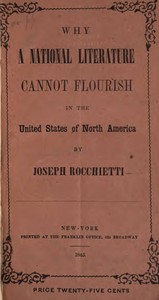
For Why a National Literature Cannot Flourish in the United States of North America — Context and Discussion, the stored edition analysis reports 29,984 words, 2 hr 11 min estimated reading time, and 3 detected text sections.
The text analysis averages about 27.7 words per sentence, while the detected sections provide another way to judge how the source is divided.
Project Gutenberg metadata also associates the work with “American literature,” connecting these edition facts with the source record’s subject description.
Explore this collection
These alternatives are selected using recorded categories and estimated reading time.
About 129 minutes
Historical Psychological Social Fiction
29,606 recorded words. 2 minutes difference from this book's estimate.
View Gutenberg source #73662About 135 minutes
Historical Psychological Social Fiction
31,047 recorded words. 4 minutes difference from this book's estimate.
View Gutenberg source #76696About 121 minutes
Historical Psychological Social Fiction
27,708 recorded words. 10 minutes difference from this book's estimate.
View Gutenberg source #93Search stored excerpts and compare books → Choose by your preferences →
Choices use stored catalog measurements. Estimates vary with reading speed. A shared category is a catalog label, not a claim that two books have the same argument or literary quality.
Search reads excerpt text stored with this catalog and links to its associated Gutenberg record. The connection is stored in the site database; this tool does not recheck that every excerpt is word-for-word identical to that external record. Excerpt search does not cover every chapter and does not verify historical publication dates.
Catalog snapshot checked: 2026-09-25. Coverage: 98 public books, 98 available source excerpts.
Calculated from edition completeness, EPUB availability, text structure and catalogue metadata. Not a user rating.
Total of 100 points, scaled to a 2.5-5.0 range. Editions with an empty description or a missing EPUB file are not scored.
Public-domain source text
The source text is kept in the dedicated reader, separate from this catalogue record and its commentary.
Joseph Rocchietti opens his 1845 polemic with a direct challenge to the notion that America is too young for a national literature. He insists that the American people are not new, having brought with them the laws, religions, and learning of Europe. The argument hinges on a distinction between new soil and an inherited culture, setting up a series of critiques that move from the general to the specific.
The book's structure is itself a statement: ten chapters that tackle everything from newspapers to international copyright, each building a case against the flourishing of a distinct American literary voice. Rocchietti's voice is urgent, often addressing his countrymen directly, and he peppers his prose with references to European thinkers, from La Bruyère to Machiavelli, to bolster his claims.
Rocchietti's first chapter establishes the central paradox: the American soil is new, but the people are not. He argues that the United States is composed of colonies from the old continent, carrying with them 'the very laws, religions, learning, languages, prejudices, arts, and literature of the old continent.' This inheritance, he claims, should make a national literature possible, yet it does not flourish. The problem, then, is not youth but something else—a failure of will or circumstance that the subsequent chapters will dissect.
The argument is structured as a series of negations: America is not a nation of Indians beginning civilization anew; it is not a blank slate. Rocchietti uses historical comparison to undermine the excuse of newness, pointing to the classical writers of mother countries as belonging to Americans as well. This move is typical of his method: he reframes the debate by shifting the ground from age to quality and independence.
In chapters on American theatres and newspapers, Rocchietti turns to the institutions that shape public taste. He notes that ten years before his writing, theatres were 'thought immoral places,' and that Niblo's theatre was only frequented by the best class because it passed under the guise of a garden. This observation ties the state of the theatre to the reputation of literature itself: talented writers have not displayed their genius in drama because the stage is in bad repute.
He contrasts this with ancient Greece, where theatre was used to instruct and inculcate morals without preaching precepts. The implication is clear: American theatre, by failing to achieve moral seriousness, has abandoned a key branch of literature. Rocchietti's critique of newspapers is similarly pointed, though the excerpts only hint at his broader argument about their role in shaping a superficial literary culture.
Rocchietti's defense of Machiavelli is one of the most striking passages in the excerpts. He takes issue with American writer J.T. Headley, who in his letters repeated the English slander that Machiavelli loved mankind for their contempt. Rocchietti counters that Il Principe is 'but a long irony,' and that Machiavelli was as noble a republican as Brutus or Cato. He calls for the word 'Machiavelism' to be removed from English and American dictionaries.
This episode illustrates a recurring concern: the dependence of American writers on British judgments. Rocchietti argues that a writer must write 'with the feeling of a citizen of the world,' and that national selfishness keeps literature in its clutches. He extends this to a broader point about intermarriage between nations improving the race, a curious biological metaphor for cultural cross-pollination.
The book's ten chapters move from a general premise (the people are not new) through a series of specific critiques (fashionable literature, religious mixing, newspapers, tourists, theatres, politics, laws, religion) to a concluding chapter on international copyright. This structure is itself an argument: each chapter isolates a factor that prevents literature from flourishing, and the cumulative effect is a diagnosis of American culture as derivative and fragmented.
Rocchietti's method is to state a problem, offer evidence from observation or history, and then propose a corrective. For example, after criticizing travel writers who go abroad to show superiority, he concludes that 'a man of letters is indebted to all nations for his discrimination, and wisdom.' The final chapter on copyright is the most concrete prescription, suggesting that legal reform might remove one obstacle to literary independence.
Rocchietti's essay is best read as a series of interconnected arguments rather than a linear treatise. Readers may find it useful to track how each chapter returns to the central question of why American literature remains dependent on European models. The book's value lies less in its conclusions than in the specific observations—about theatre, travel writing, and the reception of Machiavelli—that reveal the texture of mid-19th-century American literary culture.
Rocchietti’s frustration with borrowed voices reminded me of evenings spent rereading old sea stories—lonely, northern, half-lit. The Captain of the Polestar, and Other Tales — A Reader’s Guide stirred the same quiet ache: the sense that some places never find their own words, only echoes of distant shores. That wistfulness lingers long after the page closes.
Your answers remain private and are stored only in this browser.