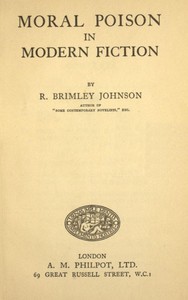
R. Brimley Johnson opens Moral Poison in Modern Fiction with a quotation that sets the tone: 'They struggled along like the rest of their young world, the eye for the eye, the tooth for the tooth, lust and loving alike only in return for loving and lust.' The sentence, drawn from a contemporary novel, encapsulates Johnson's concern that fiction of the 1910s reduces love to a transactional, physical exchange. Writing as a reviewer, he claims his evidence comes from novels encountered 'in the day's work,' not from a systematic search. This framing positions the book as a critic's immediate response to a perceived trend, rather than a detached academic study.
Diction of Desire: The Language of Physical Passion
Johnson repeatedly quotes novelists who use a vocabulary of intensity and transience to describe love. He cites Gilbert Cannan's Matilda, where love is 'a kiss of the lips, a surrender to the flood of perilous feeling, a tampering with forces that might or might not sweep you to ruin.' The diction here—'flood,' 'perilous,' 'tampering'—frames emotion as a dangerous, uncontrollable force. Similarly, W. L. George's character Victoria declares love 'too big to stay inside' marriage, calling it 'as light airs, imponderable; so fierce that all things it touches it burns.' Johnson highlights how these metaphors of air and fire strip love of permanence, presenting it as a fleeting, consuming sensation rather than a stable bond.
Dialogue as Doctrine: How Characters Preach a New Morality
Johnson’s method relies heavily on quoted dialogue, which he treats as direct authorial teaching. In Cannan's work, a character asks: 'Does any man want any woman, or any woman any man? Are these wild flashes more than things of a moment? … Why property? Why impossible pledges? Why pretend so much that is obviously false?' The rhetorical questions, Johnson argues, are not merely character speech but a 'formally stated' philosophy. He notes that such views appear 'without argument or justification' in second-rate fiction, reaching readers 'least qualified to resist evil influence.' The dialogue thus functions as a vehicle for doctrine, bypassing narrative nuance.
The Sex-Conflict Metaphor: Love as War and Conquest
Johnson identifies a recurring structural metaphor: love as a 'sex-conflict' where the man 'has to make war, to conquer.' He quotes a passage where a woman begs her lover 'to hurt her, to set his imprint upon her' and wears 'the slave look' even when 'about to conquer.' This language of dominance and submission, Johnson contends, reduces intimacy to a power struggle. He juxtaposes this with a crude street dialect: 'If yer lives alone nothing 'appens … But when yer've got a 'usband, things 'as wot they calls zest … if 'e do come 'ome … p'r'aps 'e'll give yer one in the mouf.' The parallel suggests that high and low fiction alike propagate a vision of love rooted in violence and inequality.
The Reviewer's Lens: Evidence from the Day's Work
Johnson’s foreword insists he has 'not systematically searched modern fiction' but draws on novels that 'came before me in the day's work, as a reviewer.' This methodological note is crucial: it limits his evidence to a sample of convenience, yet he generalizes to 'an immense number of novels.' The excerpts he selects—from Cannan, George, and others—are presented as representative, but the reader must weigh whether they reflect a broad trend or a selective polemic. Johnson also clarifies he is 'not here concerned with the cause or motive of literature, but with its effect,' a distinction that shapes his argument as a moral critique rather than literary analysis.
Johnson’s book is best read as a document of its time—a post-war moralist’s alarm at the frankness of Edwardian and early modernist fiction. His reliance on quoted dialogue and metaphor offers a focused, if partial, view of how certain novelists wrote about desire. Readers should note that Johnson’s evidence is anecdotal, drawn from his reviewing practice, and that his conclusions reflect a specific ethical framework. The value of Moral Poison in Modern Fiction lies less in its verdict than in the window it opens onto early twentieth-century debates about literature’s influence on conduct.
That old polemic about moral poison stayed with me because it made me feel the ache of what those writers were missing—the quiet things that outlast a fever. It reminded me of a book I once sat with, Staccato Notes of a Vanished Summer (from Literature and Life) — Reading Companion, where nothing burns, and somehow the light lingers softer. Desire fades, but that hush? That stays.