About 488 minutes
The orphan nieces — Background and Themes
Science Fiction Utopias
112,099 recorded words. 97 minutes difference from this book's estimate.
View Gutenberg source #76970
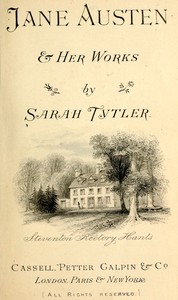
The catalog record for Jane Austen and her works — Key Ideas to Explore provides practical reading context through 134,404 words, 9 hr 45 min estimated reading time, and 20 detected text sections.
The text analysis averages about 21.1 words per sentence, while the detected sections provide another way to judge how the source is divided.
Project Gutenberg metadata also associates the work with “Women and literature -- England -- History -- 19th century,” connecting these edition facts with the source record’s subject description.
Explore this collection
These alternatives are selected using recorded categories and estimated reading time.
About 488 minutes
Science Fiction Utopias
112,099 recorded words. 97 minutes difference from this book's estimate.
View Gutenberg source #76970About 722 minutes
Science Fiction Utopias
165,974 recorded words. 137 minutes difference from this book's estimate.
View Gutenberg source #31132About 740 minutes
Science Fiction Utopias
170,099 recorded words. 155 minutes difference from this book's estimate.
View Gutenberg source #10631Search stored excerpts and compare books → Choose by your preferences →
Choices use stored catalog measurements. Estimates vary with reading speed. A shared category is a catalog label, not a claim that two books have the same argument or literary quality.
Search reads excerpt text stored with this catalog and links to its associated Gutenberg record. The connection is stored in the site database; this tool does not recheck that every excerpt is word-for-word identical to that external record. Excerpt search does not cover every chapter and does not verify historical publication dates.
Catalog snapshot checked: 2026-09-25. Coverage: 98 public books, 98 available source excerpts.
Calculated from edition completeness, EPUB availability, text structure and catalogue metadata. Not a user rating.
Total of 100 points, scaled to a 2.5-5.0 range. Editions with an empty description or a missing EPUB file are not scored.
Public-domain source text
The source text is kept in the dedicated reader, separate from this catalogue record and its commentary.
Sarah Tytler opens her 1880 volume with a frank admission: she has condensed Austen's novels 'with reverent hands' to make them accessible to young readers 'apt to be wearied by the slightest diffuseness.' This is not a neutral edition. Tytler arranges the tales by compositional order, not publication date, so that 'the growth of the author's mind and taste' can be observed. She draws exclusively on the Austen-Leigh memoir for biographical facts, and includes a frontispiece copy of Cassandra Austen's sketch. Throughout, Tytler's own critical judgments are prominent: she calls Northanger Abbey 'among the author's masterpieces' yet faults it for lacking unity and for an 'almost incessant banter' that can fatigue the reader.
Tytler explicitly addresses two readerships. She hopes to 'send many a young student' to the complete novels, but she also writes for an 'over-wrought, and in some respects over-read, generation' whom she fears is drawn to 'coarse, crude mental stimulants.' Her preface warns that Austen's 'fine sense and abounding humour' will fall flat on such a public. Yet she believes 'budding intelligence may be drawn out, not stultified' by Austen's work. This defensive posture shapes her editorial choices: she condenses to prevent weariness, and she inserts footnotes explaining obsolete customs—such as the 'nodding plumes of ostrich feathers' ladies wore—so that modern readers can grasp the social texture Austen took for granted.
Tytler devotes sustained critical attention to Northanger Abbey, calling it 'among the author's masterpieces' for its 'incisive' writing and 'dry and sparkling' wit. Yet she also identifies specific weaknesses: the novel 'lacks unity' and 'does not grow out of itself in close sequence, like Emma.' She argues that 'strong realism and airy burlesque do not match quite well together,' and points to 'considerable improbabilities.' Most strikingly, she finds no trace of the 'lurking pathos and pensive charm' that distinguishes Persuasion. Instead, the banter has 'a certain hardness' that she attributes to 'the unripe youth of the author.' Tytler's willingness to praise and then qualify—even within the same paragraph—gives her criticism a particular edge.
Tytler's footnotes do more than gloss references; they reveal her own tastes and period assumptions. She laments the decline of muslin, asking 'Will its simple, elegant, once wide reign never return?' She explains that the term 'quiz' was 'half coveted, half dreaded' in Austen's day, and speculates that Austen herself 'must have been called a quiz.' She defends Mrs. Radcliffe's horrors as 'well principled, and free from inherent moral coarseness.' These asides create a running dialogue between Tytler and her reader, one that occasionally overrides Austen's own voice. The footnotes also document changes in fashion and language—from sea-bathing resorts to the 'calico balls' that replaced muslin—offering a Victorian lens on Regency life.
Tytler states that she has 'used my own judgment in the selection of the stories, and in the degree and manner in which I have condensed them.' She claims to preserve Austen's own words 'wherever it has been possible,' but the act of abridging is itself interpretive. By choosing which scenes to retain and which to cut, Tytler shapes the reader's experience of plot and character. She also inserts her own commentary, such as calling attention to 'an unrivalled piece of art' that a hasty reader might miss. The result is a hybrid text: part Austen, part Tytler. Readers approaching the originals through this volume will encounter a filtered Austen, one whose 'consummate art' is constantly mediated by a Victorian editor's sense of what young people need.
Tytler's book is best read as a period document of literary reception rather than a substitute for Austen's novels. Her sharp judgments—on Northanger Abbey's unevenness, on the moral quality of Gothic fiction, on the 'abnormal school' of contemporary novels—illuminate late-Victorian tastes. Readers interested in how Austen was packaged for a new generation will find Tytler's editorial choices as revealing as her subject.
Reading Tytler’s gentle defense of Austen’s refinement, I found myself thinking of her footnotes—the way she pauses to explain an ostrich feather or a “quiz.” It reminded me of another quiet keeper of context, A History of American Literature Since 1870 — Story, Setting & Ideas, which holds its own era’s particulars with the same unhurried care, as if dusting a shelf of old letters.
Answer a few questions and save a private reflection on this device.