About 263 minutes
The other Miller girl — Story, Setting & Ideas
Fantasy Juvenile Worlds
60,424 recorded words. 2 minutes difference from this book's estimate.
View Gutenberg source #73780
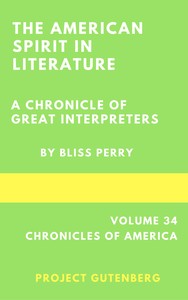
The source record for The American Spirit in Literature: A Chronicle of Great Interpreters — Context and Discussion measures this digital text at 60,804 words, 4 hr 25 min estimated reading time, and 9 detected text sections.
The text analysis averages about 20.2 words per sentence, while the detected sections provide another way to judge how the source is divided.
Project Gutenberg metadata also associates the work with “American literature -- History and criticism,” connecting these edition facts with the source record’s subject description.
Explore this collection
These alternatives are selected using recorded categories and estimated reading time.
About 263 minutes
Fantasy Juvenile Worlds
60,424 recorded words. 2 minutes difference from this book's estimate.
View Gutenberg source #73780About 260 minutes
Fantasy Juvenile Worlds
59,608 recorded words. 5 minutes difference from this book's estimate.
View Gutenberg source #288About 278 minutes
Fantasy Juvenile Worlds
63,891 recorded words. 13 minutes difference from this book's estimate.
View Gutenberg source #18730Search stored excerpts and compare books → Choose by your preferences →
Choices use stored catalog measurements. Estimates vary with reading speed. A shared category is a catalog label, not a claim that two books have the same argument or literary quality.
Search reads excerpt text stored with this catalog and links to its associated Gutenberg record. The connection is stored in the site database; this tool does not recheck that every excerpt is word-for-word identical to that external record. Excerpt search does not cover every chapter and does not verify historical publication dates.
Catalog snapshot checked: 2026-09-25. Coverage: 98 public books, 98 available source excerpts.
Calculated from edition completeness, EPUB availability, text structure and catalogue metadata. Not a user rating.
Total of 100 points, scaled to a 2.5-5.0 range. Editions with an empty description or a missing EPUB file are not scored.
Public-domain source text
The source text is kept in the dedicated reader, separate from this catalogue record and its commentary.
Perry begins not with a writer but with a national condition: 'The United States of America has been from the beginning in a perpetual change.' The opening chapter, 'The Pioneers,' grounds literary expression in the physical and mental restlessness of exploration. He quotes Roger Williams—'We are but strangers in an inn, but passengers in a ship'—to argue that the 'instinct of the camper' stamped itself on American thought. This framing, drawn from the Elizabethan era, sets up literature as a response to transiency and experiment.
The excerpts then leap to Longfellow, whom Perry treats as the supreme 'international interpreter.' Rather than narrating a life, Perry dissects Longfellow's linguistic talent, his sympathy for 'freedom and great ideas,' and his ability to translate Europe to America. The analysis is built on specific works: Evangeline, Hiawatha, The Building of the Ship, and the sonnets. Perry notes that The Psalm of Life and Excelsior 'paid the price of a too apt adjustment to the ethical mood of an earnest moment.'
Perry's first chapter does not introduce a single author but instead establishes a thesis: American literature emerges from a sense of uncertainty. He cites Alexander Hamilton's lack of 'firm conviction as to its permanence' regarding the Constitution and Lincoln's testing of 'whether this nation... can long endure.' The physical restlessness of Americans, Perry argues, is 'largely due to the experimental character of the exploration and development of this continent.' This is not a conventional literary history opening; it is a meditation on national psychology. Perry uses the metaphor of tent-dwellers: 'Today they settle here, and tomorrow they have struck camp and are gone.' The pioneers, whether saints like John Cotton or soldiers like John Smith, shared this transiency. The reader should watch how Perry returns to this idea of impermanence as he discusses later writers—it is the thread that ties his chronicle together.
The Longfellow section is the most detailed in the excerpts. Perry emphasizes not just Longfellow's popularity but his specific skills: 'linguistic talent helped him to penetrate the secrets of alien ways of thought and speech.' He understood Italy, Spain, Holland, France, Germany—'from the Revival of Learning to the middle of the nineteenth century.' Perry calls him 'the most resourceful of international interpreters.' The evidence is in Longfellow's works: Evangeline, Hiawatha, and The Courtship of Miles Standish use American themes, but his sonnets on Chaucer, Milton, and Dante are 'among the imperishable treasures of the English language.' Perry also quotes Hamilton Mabie's long tribute, which lists Longfellow's 'simplicity,' 'tranquil and deep-seated optimism,' and 'unaffected and beautiful democracy.' Notably, Perry acknowledges that The Psalm of Life and Excelsior are dated—they 'paid the price of a too apt adjustment to the ethical mood of an earnest moment.'
Perry's critical voice is evident in how he selects and judges. He does not simply praise; he discriminates. Of Longfellow's trilogy Christus, he writes that it 'added little to a reputation won in other fields.' He identifies Longfellow's true strength as a lyric poet, not a dramatist. The evidence for this judgment comes from Perry's own reading: he lists specific poems—'The Skeleton in Armor,' 'Paul Revere's Ride,' 'The Wreck of the Hesperus'—as ballads 'that stir men still.' He also highlights the sonnets and occasional verses like 'Morituri Salutamus' as showing 'tenderness of affection' and 'ripeness of technical skill.' This pattern of assertion backed by named works is consistent. Perry also uses external testimony: Lincoln's tears at The Building of the Ship and Mabie's dedicatory speech. The reader should note that Perry's own prose is measured, avoiding hyperbole, and he often lets quoted authorities carry the weight of praise.
The excerpts cover only the opening chapter and part of the Longfellow section. The full book contains chapters on other writers—likely including Franklin, Irving, Cooper, Emerson, Hawthorne, Poe, Whitman, and others—but the excerpts do not reveal Perry's treatment of them. The reader cannot know whether Perry applies the same 'experimental nation' thesis to later figures, or how he handles writers who do not fit the 'interpreter' mold. The catalog subjects list 'American literature -- History and criticism,' and the title promises 'great interpreters,' but the excerpts show only two examples: the generalized pioneers and Longfellow. Perry's method of using quoted authorities (Mabie, Lincoln) may recur, but this is uncertain. The reader should approach the full text expecting a selective, thesis-driven chronicle rather than a comprehensive survey, and should watch for how Perry connects each writer back to the opening theme of perpetual change.
Perry's chronicle is best read as a series of interpretive essays rather than a neutral history. The opening chapter establishes a lens—the American as tent-dweller, the nation as experiment—that may or may not fit every writer he discusses. The Longfellow section demonstrates Perry's willingness to combine biographical detail, textual evidence, and critical judgment, but the excerpts are too brief to reveal his full range. Readers interested in Perry's own critical stance should note his avoidance of stock praise and his habit of naming specific poems and prose works as evidence. The book is part of the Chronicles of America series, which suggests a broad audience, but Perry's prose is scholarly in its precision.
Perry’s Longfellow, that patient interpreter of foreign shores, always made me think of how a book can hold two homes at once. There is a gentle ache in that, the same quiet threshold I find in Lore of Proserpine — A Reader’s Guide, where the underworld’s half-light feels less like exile and more like a familiar, unhurried pause between seasons.
A brief reflection can help important ideas stay with you longer.