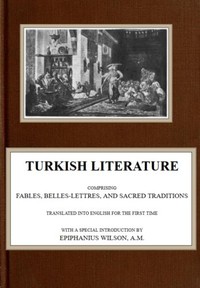
The anthology opens with a formal panegyric to Sultan Mustapha, employing hyperbolic comparisons to legendary figures like Rustem and Alexander. The verse relies on repetitive parallelism—'Shah of the moon and mirror of success'—and a catalog of virtues that blends celestial imagery with martial prowess. This style, typical of Ottoman court poetry, prioritizes grandeur over narrative progression.
In contrast, the prose introduction by Epiphanius Wilson adopts a detached, scholarly tone, situating Turkish literature as a hybrid of Eastern and European influences. The juxtaposition of these two voices—one ornate and laudatory, the other analytical—sets up a tension that runs through the collection.
Panegyric as Political Performance
The excerpt from the poem praising Sultan Mustapha exemplifies the Ottoman tradition of kaside (panegyric ode). The speaker compares the sultan to 'an angel or a Jupiter,' and claims that 'were Feridum to see his greatness now, / He would have promised fealty to his house.' Such hyperbole is not mere flattery; it functions as a political ritual, reinforcing the sultan’s divine right and martial authority. The verse also employs a repetitive structure—each couplet amplifying the same idea—which creates a hypnotic, incantatory effect. The imagery is consistently cosmic: the sultan is a 'sun of bright prosperity,' his justice 'the ruler of the world.' This suggests that the poem’s primary purpose is not to inform but to perform allegiance through stylized language.
Shifts in Narrative Pace and Voice
The collection moves between rapid, declarative verse and slower, explanatory prose. In the panegyric, the pace is relentless: each line piles on another epithet, with no pause for reflection. The introduction, by contrast, proceeds deliberately, offering historical context and categorizing literary periods. This shift in pace mirrors a change in voice—from the collective, ceremonial 'we' of the court poet to the singular, analytical 'I' of the editor. Readers attuned to rhythm will notice how the verse’s repetitive meter (e.g., 'He is a hero of full gallant mien, / Whose aspect is the dread of Rusteman') contrasts with the prose’s measured clauses. Such variations suggest that the anthology deliberately juxtaposes different modes of address: the public, performative voice versus the private, interpretive one.
Recurring Motifs of Light and Power
Throughout the excerpted verse, light imagery dominates: the sultan is a 'sun of bright prosperity,' a 'mirror of success,' and 'Lord of Light.' This motif extends to descriptions of his sword, which 'gleams,' and his presence, which 'crushed in agony his foes.' The repetition of light as a symbol of authority is consistent with Islamic and Persianate literary traditions, where rulers are often associated with divine illumination. The prose introduction, however, reframes this motif in secular terms, describing Turkey as 'an oriental country transplanted into a European environment.' This shift from sacred to geopolitical language highlights a tension between the verse’s metaphysical claims and the editor’s worldly analysis. Readers may note how the same imagery—light, power, transcendence—is deployed for different rhetorical ends in different sections.
This edition invites readers to attend to the interplay between form and function: how panegyric verse structures political ideology, and how editorial prose reframes it for a Western audience. Pay particular attention to the shifts in register between sections—the ceremonial versus the scholarly—and consider how each mode shapes the reader’s understanding of Turkish literary identity. The collection rewards those who read for voice as much as for content.
I found this old Turkish anthology, with its courtly poems and sacred tales, and it left a strange quietness behind, the way certain stories do. That feeling of being caught between worlds, of fate pulling against choice, reminded me of A gypsy against her will — Story, Setting & Ideas, which lingers in its own hushed way. Some books simply stay.