About 418 minutes
Miss Con — Story, Setting & Ideas
Fantasy Juvenile Worlds
96,090 recorded words. 10 minutes difference from this book's estimate.
View Gutenberg source #73389
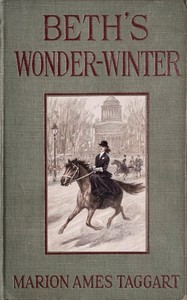
Beth's wonder-winter — A Reader’s Guide can be approached with a clearer sense of reading commitment from its source measurements: 93,683 words, 6 hr 48 min estimated reading time, and 26 detected text sections.
The text analysis averages about 16.3 words per sentence, while the detected sections provide another way to judge how the source is divided.
Project Gutenberg metadata also associates the work with “Christmas stories,” connecting these edition facts with the source record’s subject description.
Explore this collection
These alternatives are selected using recorded categories and estimated reading time.
About 418 minutes
Fantasy Juvenile Worlds
96,090 recorded words. 10 minutes difference from this book's estimate.
View Gutenberg source #73389About 392 minutes
Fantasy Juvenile Worlds
90,080 recorded words. 16 minutes difference from this book's estimate.
View Gutenberg source #2885About 384 minutes
Fantasy Juvenile Worlds
88,165 recorded words. 24 minutes difference from this book's estimate.
View Gutenberg source #1550Search stored excerpts and compare books → Choose by your preferences →
Choices use stored catalog measurements. Estimates vary with reading speed. A shared category is a catalog label, not a claim that two books have the same argument or literary quality.
Search reads excerpt text stored with this catalog and links to its associated Gutenberg record. The connection is stored in the site database; this tool does not recheck that every excerpt is word-for-word identical to that external record. Excerpt search does not cover every chapter and does not verify historical publication dates.
Catalog snapshot checked: 2026-09-25. Coverage: 98 public books, 98 available source excerpts.
Calculated from edition completeness, EPUB availability, text structure and catalogue metadata. Not a user rating.
Total of 100 points, scaled to a 2.5-5.0 range. Editions with an empty description or a missing EPUB file are not scored.
Public-domain source text
The source text is kept in the dedicated reader, separate from this catalogue record and its commentary.
The opening chapter of Beth’s Wonder-Winter introduces Beth Bristead through a small domestic conflict: her aunt Rebecca demands to know how her apron was torn. Beth’s reply—‘It tore itself—kind of’—prompts a scolding, but her explanation reveals a habit of climbing apple trees and a vocabulary that includes words like ‘snatchified.’ The exchange establishes Beth as a truthful, imaginative child navigating adult expectations. The catalog subjects list Christmas, New York City, girls, and ponies, but the excerpts show that the pony, Trump, appears only later, and the Christmas element is not yet evident. Instead, the early focus is on Beth’s relationship with her strict aunt and her adjustment to a new environment.
Beth’s dialogue in the opening scene reveals a child who is both obedient and inventive. When asked how her apron tore, she first says it ‘tore itself—kind of,’ then offers a detailed account of hanging it on a tree branch and taking it off ‘snatchified.’ The word is not standard English, but it captures her hurried, physical experience. Aunt Rebecca’s response—‘Aprons do not tear themselves’—shows the adult insistence on literal truth. Beth’s flush and her habit of obedience suggest she has been raised to be truthful, yet her imagination colors her speech. This tension between a child’s perspective and adult rules runs through the excerpts.
When Beth rides Trump in Central Park, the narrative emphasizes her lack of confidence. She tells Tim, the groom, that she is glad Trump is short: ‘It would not be far to fall off.’ Tim notes that Mr. Cortlandt chose the pony for its gentleness. Beth’s affection for the animal is immediate—she says she ‘worshiped him the moment I saw’—but she worries about leaving him when spring comes. The park setting introduces a social world of riders, policemen, and a crowd. Beth’s intervention in the purse-snatching accusation shows her acting on instinct: she dismounts, questions the child, and spots the purse still attached to the accuser’s muff. The episode demonstrates her empathy and quick observation, traits not listed in the catalog subjects.
The purse incident in the park is the most dramatic excerpt. A policeman threatens to ‘run in’ a small Italian girl for stealing; the accuser clamors for arrest. Beth notices the purse dangling from the woman’s muff bar and exposes the mistake. The child collapses in relief, and Beth offers her pony to walk home. The scene is not about Christmas or ponies per se, but about justice and compassion. The catalog subjects do not mention class or ethnicity, yet the Italian child’s ‘thin body’ and ‘dark eyes’ contrast with Beth’s ‘plump, rosy’ appearance. The story uses a winter setting in New York to stage a moral lesson, but the excerpts leave unclear whether this is a single episode or part of a larger pattern.
Readers should note that the excerpts cover only the first few chapters and one later riding scene. The title promises a ‘wonder-winter,’ but the catalog subjects—Christmas, ponies, New York—are only partially realized in these passages. Beth’s character emerges through small actions: her tree-climbing, her attachment to Trump, her defense of a stranger. The story’s moral weight falls on her choices, not on seasonal festivities. Pay attention to how the author uses setting and dialogue to define Beth’s world.
Reading about Beth’s quiet courage with the falsely accused boy made me recall a winter afternoon from my own childhood—how I once stood silent when a classmate was blamed for something I knew they hadn’t done. That unease came back when I first opened Worthy of his name — Story, Setting & Ideas, and felt the same gentle ache of moral noticing, unhurried and true.
Capture what you thought, learned, and would like to remember.