About 206 minutes
The old house in the city — A Closer Reading
Fantasy Juvenile Worlds
47,365 recorded words. 3 minutes difference from this book's estimate.
View Gutenberg source #73596
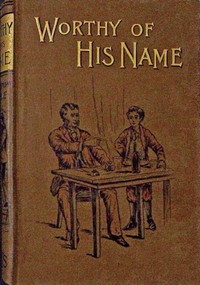
For Worthy of his name — Story, Setting & Ideas, the stored edition analysis reports 46,670 words, 3 hr 23 min estimated reading time, and 5 detected text sections.
The text analysis averages about 15.3 words per sentence, while the detected sections provide another way to judge how the source is divided.
Project Gutenberg metadata also associates the work with “Christian life -- Juvenile fiction,” connecting these edition facts with the source record’s subject description.
Explore this collection
These alternatives are selected using recorded categories and estimated reading time.
About 206 minutes
Fantasy Juvenile Worlds
47,365 recorded words. 3 minutes difference from this book's estimate.
View Gutenberg source #73596About 199 minutes
Fantasy Juvenile Worlds
45,664 recorded words. 4 minutes difference from this book's estimate.
View Gutenberg source #72840About 193 minutes
Fantasy Juvenile Worlds
44,233 recorded words. 10 minutes difference from this book's estimate.
View Gutenberg source #73528Search stored excerpts and compare books → Choose by your preferences →
Choices use stored catalog measurements. Estimates vary with reading speed. A shared category is a catalog label, not a claim that two books have the same argument or literary quality.
Search reads excerpt text stored with this catalog and links to its associated Gutenberg record. The connection is stored in the site database; this tool does not recheck that every excerpt is word-for-word identical to that external record. Excerpt search does not cover every chapter and does not verify historical publication dates.
Catalog snapshot checked: 2026-09-25. Coverage: 98 public books, 98 available source excerpts.
Calculated from edition completeness, EPUB availability, text structure and catalogue metadata. Not a user rating.
Total of 100 points, scaled to a 2.5-5.0 range. Editions with an empty description or a missing EPUB file are not scored.
Public-domain source text
The source text is kept in the dedicated reader, separate from this catalogue record and its commentary.
From its first chapter, Worthy of His Name establishes a world where a single word—'gentleman'—carries contested meanings. Sally Dent calls her new lodger 'a real gentleman' because he pays rent in advance and promises to leave when he cannot pay; a neighbour retorts that the same man came home 'drunk as a lord.' The dispute is not merely comic. Thorne uses it to expose how the same behaviour can be read as respectability or disgrace depending on the observer's tolerance. The dialogue is dense with class markers: Sally's dropped h's and easy forgiveness contrast with the fence-mender's sarcasm and the gaunt Mrs. Minn's sharper judgments. Within a few paragraphs, the novel has sketched a community where moral standing is negotiated in everyday talk, and where a boy—Gus—must learn what it truly means to be worthy of a name.
Thorne renders working-class speech with unusual care. Sally Dent's idiom is not a uniform stage dialect but a consistent idiolect: she says 'he give me a fortnight's rent' and 'I 'opes I knows how to make allowance.' Her grammar is nonstandard, yet her moral reasoning is nuanced. When accused of tolerating a drunkard, she replies, 'We've all our little weaknesses, and I 'opes I knows how to make allowance.' The narrator does not correct her; instead, the description of her 'dirty, torn gown' and 'grimy doorstep' undercuts her tolerance without commentary. The effect is that Sally's voice carries its own dignity even as the physical details indict her carelessness. Later, the policeman's report that Gus 'told it with such simple directness and with such a guileless look in his blue eyes' shows that the same community can recognise truthfulness across class lines. Thorne uses dialect not as a joke but as a precise tool for characterisation.
The epigraph from Guido Guinizelli—'Let no man predicate / That aught the name of gentleness should have, / Even in a king's estate, / Except the heart there be a gentleman's'—signals that the book will test the meaning of gentility. Chapter VII is titled 'A Chivalrous Exploit,' and the contents page shows Gus 'wins a name' through action. The excerpts do not reveal the exploit, but the pattern is clear: Gus must prove that inner worth, not birth or money, makes a gentleman. This chivalric theme is embedded in a realistic setting of strikes, burglary, and temperance. The colonel, a Crimean veteran, is described as 'kinder than he appeared,' with a 'warm heart' beneath 'surface severity.' The novel thus aligns military honour with Christian forbearance. For young readers, the message is that courage and honesty—not social standing—earn the title 'worthy of his name.'
Chapter XIV, 'Good-Bye to Lavender Terrace,' centres on a failed burglary at Colonel Carruthers's house. Gus is caught with the burglars—Lucas and his son—but his story 'never varied.' The policemen, 'accustomed to believe the worst of human nature,' are impressed by his 'simple directness.' Thorne uses the legal investigation to sharpen moral distinctions: Sally Dent, betrayed by Lucas's unpaid rent, renounces Gus with theatrical anger ('he shall never darken my doors again'), while the police officer defends him ('The little lad's honest enough'). The episode forces Gus to choose between loyalty to his father-figure Lucas and the truth. The colonel's return introduces a figure of authority who will 'decide what shall be done with the poor little prisoner.' The burglary is not just a plot device; it is a crucible that exposes each character's true nature—Sally's self-interest, Lucas's deceit, Gus's integrity.
The catalog lists 'Temperance' and 'Alcoholism' as subjects, and the opening chapter introduces both through Sally's lodger and Sally herself. The narrator notes that Sally's 'ruddy hue suggested that she too might have her "little weakness."' The phrase 'little weakness' is Sally's own euphemism, and the narrator echoes it ironically. Later, Sally admits her head is 'apt to be in rather a hazy condition at that period of the day' when asked about Lucas's movements. Thorne does not preach; she lets the physical details—the dirty doorstep, the torn gown, the hazy memory—accumulate into a portrait of neglect. The lodger's drunkenness is described as 'behaved himself like a gentleman, and didn't make no noise,' a chilling standard. The novel thus embeds its temperance message in the texture of daily life, showing how drink erodes reliability and self-respect without resorting to melodramatic ruin.
Readers attentive to Thorne's craft will notice how she uses small details—a grimy doorstep, a guileless look, a misremembered hour—to build a moral universe. The novel rewards close attention to its dialogue, where characters reveal themselves through what they say and what they leave unsaid. Gus's journey from Lavender Terrace to the colonel's house is also a movement between registers of English, from dialect to standard speech, and between codes of honour. The epigraph's challenge—to find the gentleman's heart—is the thread that holds the story together.
Reading Worthy of His Name again, I found myself drifting back to an afternoon with The Certain Hour (Dizain des Poëtes) — Reading Notes, where passages on the quiet weight of a reputation felt like the same dusty light on a worn floorboard. Both carry a patient, almost tender honesty about how we're judged. A gentle echo, nothing more.
Capture what you thought, learned, and would like to remember.