About 688 minutes
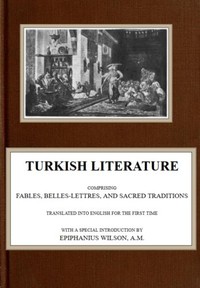
Turkish Literature; Comprising Fables, Belles-lettres, and Sacred Traditions — Text and Context
Fantasy Juvenile Worlds
158,114 recorded words. 112 minutes difference from this book's estimate.
View Gutenberg source #56464
This digital edition of Outlines of English and American Literature An Introduction to the Chief Writers of England and America, to the Books They Wrote, and to the Times in Which They Lived — Reading Notes is described by source-level measurements including 183,967 words, 13 hr 20 min estimated reading time, and 17 detected text sections.
The text analysis averages about 27.6 words per sentence, while the detected sections provide another way to judge how the source is divided.
Project Gutenberg metadata also associates the work with “American literature -- History and criticism,” connecting these edition facts with the source record’s subject description.
Explore this collection
These alternatives are selected using recorded categories and estimated reading time.
About 688 minutes
Fantasy Juvenile Worlds
158,114 recorded words. 112 minutes difference from this book's estimate.
View Gutenberg source #56464About 418 minutes
Fantasy Juvenile Worlds
96,090 recorded words. 382 minutes difference from this book's estimate.
View Gutenberg source #73389About 408 minutes
Fantasy Juvenile Worlds
93,683 recorded words. 392 minutes difference from this book's estimate.
View Gutenberg source #75689Search stored excerpts and compare books → Choose by your preferences →
Choices use stored catalog measurements. Estimates vary with reading speed. A shared category is a catalog label, not a claim that two books have the same argument or literary quality.
Search reads excerpt text stored with this catalog and links to its associated Gutenberg record. The connection is stored in the site database; this tool does not recheck that every excerpt is word-for-word identical to that external record. Excerpt search does not cover every chapter and does not verify historical publication dates.
Catalog snapshot checked: 2026-09-25. Coverage: 98 public books, 98 available source excerpts.
Calculated from edition completeness, EPUB availability, text structure and catalogue metadata. Not a user rating.
Total of 100 points, scaled to a 2.5-5.0 range. Editions with an empty description or a missing EPUB file are not scored.
Public-domain source text
The source text is kept in the dedicated reader, separate from this catalogue record and its commentary.
William J. Long opens his preface with a confession: the textbook he studied as a boy was 'a most dreary catalogue of dead authors, dead masterpieces, dead criticisms, dead ages.' That memory drives his own book, which aims to present writers not as 'dead worthies' but as 'companionable men and women.' The result is a survey that wears its opinions openly. Long does not hesitate to call Tennyson's The Princess a failure—'a moralizing intruder spoils a bit of innocent fun'—or to note that few readers now attempt its three thousand lines. Such bluntness, paired with a conversational tone, makes the volume less a reference work and more a prolonged, personal lecture.
Long’s preface is the most revealing part of the book. He describes his own youthful encounter with literary history as a 'literary sepulchre' and insists that the only valuable feature of any work is its 'vitality.' This is not a neutral stance; it is a manifesto. He quotes Pascal—'The last thing we find in making a book is to know what to put first'—and then proceeds to put his own experience first. The apology that follows is less an apology than a declaration: the book is meant to be 'winsome as a smile on a human face.' That phrase, with its deliberate homeliness, signals Long’s preference for the personal over the academic. Readers should expect a guide that judges as much as it informs.
Long’s treatment of Tennyson shows his method at work. He praises In Memoriam as 'more personal and sympathetic' than Milton’s 'Lycidas' or Shelley’s 'Adonais,' but he is sharply critical of The Princess, which he calls an attempt to combine 'an old romantic story with a modern social problem' that does not succeed. He notes that Tennyson 'does not know the answer to his own problem' and that the poem’s conclusion is 'lame and impotent.' The criticism is specific: Long objects to the mixing of genres, not to the subject matter itself. He also observes that most readers now skip the poem and remember only a few lyrics—'Sweet and Low,' 'Bugle Song'—that have become anonymous household songs. This is a pattern in Long’s writing: he measures works by their staying power with ordinary readers.
Long distinguishes between Tennyson’s Idylls of the King and his English Idyls, a distinction that reveals his interest in the local and the contemporary. He recommends starting the Idylls with 'The Passing of Arthur,' the twelfth book, because it 'reflects the noble spirit of the entire work.' But he also notes that some readers prefer Malory’s version, and he advises reading both to see how the Arthurian story 'appealed to writers of different times.' The English Idyls, by contrast, are praised for turning 'from ancient heroes to sing the romance of present-day life.' Long singles out 'Enoch Arden' as once popular but now 'in danger of being shelved' because modern readers prefer prose romance. Here, as elsewhere, Long is attentive to changing tastes and the lifespan of literary fame.
Long’s book is best approached as a period piece of literary criticism, not a neutral reference. His judgments—sometimes tart, sometimes generous—are part of the texture. Readers who want a dry chronology will be frustrated; those who enjoy a strong authorial voice will find much to argue with and enjoy. The preface’s promise to treat literature as 'a living thing' is kept, even when the living thing proves to be a little cranky.
I found myself thinking of Long’s Tennyson chapter—how he could be so warmly personal one moment, then abruptly dismissive of a favorite stanza—when I later opened the old St. Nicholas pages. That same mixture of fondness and impatience for youthful voices felt familiar there, a gentle echo of a teacher half-smiling at his own memories. Southern Stories Retold from St. Nicholas — Context and Discussion carries something of that unhurried, intimate spirit.
A brief reflection can help important ideas stay with you longer.