About 408 minutes
Beth's wonder-winter — A Reader’s Guide
Fantasy Juvenile Worlds
93,683 recorded words. 10 minutes difference from this book's estimate.
View Gutenberg source #75689
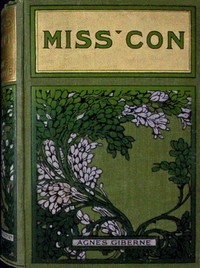
The catalog record for Miss Con — Story, Setting & Ideas provides practical reading context through 96,090 words, 6 hr 58 min estimated reading time, and 9 detected text sections.
The text analysis averages about 14.4 words per sentence, while the detected sections provide another way to judge how the source is divided.
Project Gutenberg metadata also associates the work with “Epistolary fiction,” connecting these edition facts with the source record’s subject description.
Explore this collection
These alternatives are selected using recorded categories and estimated reading time.
About 408 minutes
Fantasy Juvenile Worlds
93,683 recorded words. 10 minutes difference from this book's estimate.
View Gutenberg source #75689About 392 minutes
Fantasy Juvenile Worlds
90,080 recorded words. 26 minutes difference from this book's estimate.
View Gutenberg source #2885About 384 minutes
Fantasy Juvenile Worlds
88,165 recorded words. 34 minutes difference from this book's estimate.
View Gutenberg source #1550Search stored excerpts and compare books → Choose by your preferences →
Choices use stored catalog measurements. Estimates vary with reading speed. A shared category is a catalog label, not a claim that two books have the same argument or literary quality.
Search reads excerpt text stored with this catalog and links to its associated Gutenberg record. The connection is stored in the site database; this tool does not recheck that every excerpt is word-for-word identical to that external record. Excerpt search does not cover every chapter and does not verify historical publication dates.
Catalog snapshot checked: 2026-09-25. Coverage: 98 public books, 98 available source excerpts.
Calculated from edition completeness, EPUB availability, text structure and catalogue metadata. Not a user rating.
Total of 100 points, scaled to a 2.5-5.0 range. Editions with an empty description or a missing EPUB file are not scored.
Public-domain source text
The source text is kept in the dedicated reader, separate from this catalogue record and its commentary.
The first chapter of Miss Con opens not with the title character but with a journal entry dated February 20, recording a brother-in-law's oily satisfaction at placing Constance Conway as a governess. The phrase 'fitting of a round man into a round hole'—quickly amended to 'round woman'—signals the transactional view of women's roles that Constance will navigate. The narrative voice shifts between her diary and letters, a dual form that allows Giberne to contrast private turmoil with social performance.
Constance Conway's journal entries reveal a sharp eye for hypocrisy. She records Craven's 'oily satisfaction' and Albinia's silent compliance, noting that 'Albinia never ventures to oppose him.' Yet her own position is precarious: she has been a month in his house and receives 'plain hints that a month was enough.' The diary form lets Giberne show Constance's analytical mind at work, parsing social cues and her own constrained choices. When she later walks alone in the dale, the landscape becomes a correlative for her inner state: 'the lowering black cloud within' matches the 'heavy masses of dark cloud brooding over the upper extremity of the Dale.' The narrative insists on the physicality of emotion—'stony misery' that must be 'worked off by rapid exercise.'
Giberne devotes sustained attention to the Yorkshire setting, using it to externalize Constance's distress. The walk to the bridge is described with precise sensory detail: the 'chocolate-brown' river, 'swift and steadfast in its rush,' the 'pretty silken-coated sheep' on hillsides, and the 'old-fashioned greetings from strangers.' These observations are not mere decoration; they are the narrator's attempt to 'keep at bay' her own pain. The search for a hidden seat 'upon one flat rock, another rising a little below in just such a position as to hide me effectually' mirrors her need for concealment and control. The landscape offers a solitude that human society denies her.
The preface explicitly addresses 'young Authoresses, incipient or developed,' and the chapter titles—'Juvenile Authorship,' 'That Publisher!!'—indicate that writing is a central theme. Yet the excerpts show Constance's authorship as a private, almost guilty activity: her journal is a secret space. The tension between creative ambition and the demands of governessing is embodied in the contrast between her inner voice and the polite fictions she must maintain. When Thyrza offers 'solicitude' about her mother, Constance notes that 'that pain grows small beside the other'—the other being a disappointment connected to her writing or affections, left deliberately vague. Giberne thus suggests that literary work, for a woman, is both a refuge and a source of additional conflict.
Readers should attend to the interplay between Constance's journal and the letters from other characters, which are not included in these excerpts. The diary's immediacy may be countered by more formal or deceptive correspondence. Notice also how the landscape descriptions shift with emotional states: the 'grey yet clear evening' versus the 'lowering black cloud within.' Giberne's use of natural detail is never incidental; it is the novel's primary means of rendering interior life visible.
Reading Miss Con, I kept thinking of the governess’s quiet ache—that pull between the page and the parlor. It reminded me, somehow, of And both were young — A Reader’s Guide, a book I once leafed through on a slow afternoon. Both felt like whispered companions to that same lonely, lovely struggle.
Capture what you thought, learned, and would like to remember.