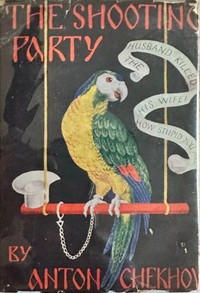
The shooting party — Inside the Classic

  6   2
Chekhov, Anton Pavlovich, 1860-1904, Chamot, A. E. (Alfred Edward), 1855-1934 [Translator] Project Gutenberg 2024
Murder -- Investigation -- Fiction; Russia -- Social life and customs -- Fiction; Man-woman relationships -- Fiction; Upper class -- Russia -- Fiction Readers of public-domain and historical texts
Project Gutenberg digital edition en

Edition facts

Words: 77,427
Reading time: 337 min
Text sections: 39
Chekhov's early novel, told by a narrator whose agitated voice shifts from fury to forced calm, uses a murder investigation frame to explore class tensions and emotional manipulation in rural Russia.
Share

The narrator's voice in The Shooting Party is immediately volatile. In the excerpt, Sergey Petrovich threatens Count Karneyev with a half-minute ultimatum—'me or him?'—then storms out, only to be intercepted by Nadia Kalinin. His internal state oscillates between theatrical rage and a clinical awareness of his own performance: he 'prepares in his mind an answer' before she even asks her question. This self-consciousness, paired with abrupt shifts in dialogue pace, suggests a narrator who is both participant and observer, unreliable in his emotions but precise in recording others' gestures.

A Voice That Wavers Between Fury and Control

The opening of the excerpt shows Sergey Petrovich erupting at the Count over Pshekhotsky, his speech punctuated by exclamation marks and imperatives: 'I demand that he shall no longer be here, and instantly, too!' Yet within moments, when speaking to Nadia, his tone becomes clipped and guarded—'What may your commands be?'—as if he has donned a mask of civility. This contrast is not merely social; it reveals a narrator who uses anger as a weapon and politeness as a shield. Chekhov lets the reader hear the strain: Nadia's voice is described as 'unnaturally deep,' and Sergey notes her 'terrible pallor.' The emotional temperature of the scene rises and falls with each exchange, making the reader watch for the next crack in composure.

The Weight of Unspoken Questions

Nadia's approach to Sergey is built on hesitation and self-deprecation. She calls her own question 'humiliating' and compares herself to Pushkin's Tatiana, a literary reference that signals her awareness of playing a role. The dialogue here is slow, almost staccato, with dashes and ellipses mimicking her faltering breath: 'My life is no life… All is dried up…' Sergey, by contrast, answers in short, formal sentences. The pacing of the scene—long pauses, interrupted clauses, the physical detail of trembling fingers—creates a sense of suffocation. Chekhov uses these structural breaks to show how power shifts between the two: she forces the confrontation, but he controls the answer.

Setting as Emotional Amplifier

The encounter takes place in a garden, between the main house and the servants' quarters—a liminal space that mirrors the characters' social and emotional positions. Sergey is leaving, Nadia intercepts him; they sit down, but the scene remains charged with movement. Earlier, the Count's drawing-room was a stage for Sergey's outburst; now the garden becomes a confessional. Chekhov does not describe the setting at length, but the shift from interior to exterior marks a change in register: from public performance to private plea. The 'small cup of coffee' Nadia carries is a mundane detail that grounds the high emotion in everyday life, a technique Chekhov would refine in his later stories.

Readers should attend to the narrator's self-awareness: Sergey Petrovich often comments on his own motives, yet his actions contradict his words. The murder investigation hinted at in the title may not be the central concern; rather, the novel seems to explore how people manipulate each other through language and silence. Pay attention to who speaks in fragments and who speaks in full sentences—Chekhov uses these patterns to map hidden hierarchies.

Related eBooks