About 177 minutes
Janet's boys — Inside the Classic
Historical Psychological Social Fiction
40,589 recorded words. 6 minutes difference from this book's estimate.
View Gutenberg source #72020
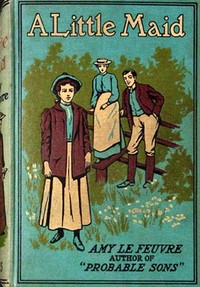
The catalog record for A little maid — Story, Setting & Ideas provides practical reading context through 41,973 words, 3 hr 3 min estimated reading time, and 4 detected text sections.
The text analysis averages about 13.2 words per sentence, while the detected sections provide another way to judge how the source is divided.
Project Gutenberg metadata also associates the work with “Christian life -- Juvenile fiction,” connecting these edition facts with the source record’s subject description.
Explore this collection
These alternatives are selected using recorded categories and estimated reading time.
About 177 minutes
Historical Psychological Social Fiction
40,589 recorded words. 6 minutes difference from this book's estimate.
View Gutenberg source #72020About 197 minutes
Historical Psychological Social Fiction
45,147 recorded words. 14 minutes difference from this book's estimate.
View Gutenberg source #72157About 149 minutes
Historical Psychological Social Fiction
34,102 recorded words. 34 minutes difference from this book's estimate.
View Gutenberg source #75600Search stored excerpts and compare books → Choose by your preferences →
Choices use stored catalog measurements. Estimates vary with reading speed. A shared category is a catalog label, not a claim that two books have the same argument or literary quality.
Search reads excerpt text stored with this catalog and links to its associated Gutenberg record. The connection is stored in the site database; this tool does not recheck that every excerpt is word-for-word identical to that external record. Excerpt search does not cover every chapter and does not verify historical publication dates.
Catalog snapshot checked: 2026-09-25. Coverage: 98 public books, 98 available source excerpts.
Calculated from edition completeness, EPUB availability, text structure and catalogue metadata. Not a user rating.
Total of 100 points, scaled to a 2.5-5.0 range. Editions with an empty description or a missing EPUB file are not scored.
Public-domain source text
The source text is kept in the dedicated reader, separate from this catalogue record and its commentary.
The first chapter places its protagonist on a doorstep in Bone Alley, a London slum, and immediately establishes a double vision: the narrator describes Peggy's shabby clothes and surroundings with precise, unsparing detail—'a faded blue felt hat, with a wisp of black ribbon and a ragged crow's feather stuck jauntily in on one side'—while also noting that 'she was a dreamer.' This tension between external squalor and internal aspiration drives the novel's language. Peggy's Cockney dialect ('You'd best be movin', Peg') is rendered phonetically, and her habit of talking to herself becomes a structural device, allowing the reader access to her thoughts without direct authorial commentary.
Le Feuvre uses nonstandard spelling and grammar to distinguish Peggy's speech from that of her employers and other rural characters. In the opening, Peggy says 'You'd best be movin',' and later she tells Ellen, 'I've see'd 'er, and a-spoken to 'er.' The narrator occasionally glosses these utterances—'She was accustomed to talk to herself'—but mostly lets the dialect stand without comment. This choice gives Peggy an authentic voice while also marking her social position. The contrast is sharp when she encounters the 'sick lady' at Mallow Farm, whose speech is unmarked. Peggy's recipe for a 'sick heart' mixes biblical quotations with her own literal phrasing: 'You keeps quiet, and you puts your mind to it.' The effect is both comic and earnest, revealing a character who translates religious doctrine into practical steps.
One of the most striking passages in the excerpts is Peggy's written 'recipe for a sick heart,' which she composes using a cookery-book and her Bible. The recipe is formatted as a list of ingredients and instructions, complete with a 'Time in making: about half an hour.' This blend of domestic and spiritual language is characteristic of Le Feuvre's method: Peggy's faith is not abstract but embodied in everyday actions. The recipe also functions as a plot device, prompting reactions from the other characters. Joyce calls it 'irreverent,' while Helen sees it as evidence that Peggy is 'one of Christ's little ones.' The sisters' differing responses—one skeptical, one protective—create a subtle tension around how Peggy's earnestness is received by those around her.
The excerpts move between two sharply contrasted settings: the London slum of Bone Alley and the rural landscape around Mallow Farm. The slum is rendered through smell ('soapsuds, cabbage, fried bacon, and fried fish') and sight ('orange-peel, broken bottles, and old tins'). The farm, by contrast, is introduced through a garden where a lady sits, and through Mrs. Webster's recipe for 'curin' spasms.' Le Feuvre does not moralize about these settings; instead, she lets the sensory details accumulate. Peggy's own language shifts slightly when she encounters the country—she speaks of 'a sick heart' rather than the more pragmatic concerns of the opening. The physical journey from London to the countryside is not described in the excerpts, but the change in atmosphere is implied by the shift in Peggy's concerns and the people she meets.
Le Feuvre reveals Peggy's character primarily through what she says and how others respond. When Peggy tells Ellen, ''Tis a sick heart she has, and you and me will see she gets it cured whiles she's here,' the reader learns both her compassion and her confidence in her own remedies. The sisters' reactions—Joyce's amusement and Helen's protective silence—further define Peggy by showing how she is perceived. The recipe scene is particularly effective: Peggy asks Helen to check the spelling, and Helen 'could not speak' when asked about the time. These small silences and exchanges build a portrait of a girl who is both naive and determined, whose faith is literal and practical. The excerpts do not reveal whether her recipe is delivered or how it is received, leaving the reader to wonder how her earnestness will fare in a world that often finds it quaint or troubling.
Readers approaching A Little Maid should attend to the interplay between Peggy's dialect and the narrator's standard English—a stylistic choice that creates distance and intimacy simultaneously. The excerpts suggest that Le Feuvre is less interested in plot than in the texture of Peggy's inner life and her interactions with a world that does not always understand her. The recipe episode, in particular, rewards close reading as a compressed example of how the novel blends domestic detail with religious earnestness.
There’s something tender about Peggy’s habit of talking to herself, finding company in her own voice. It made me think of old, well-kept houses, where every room holds a private conversation. I found a similar quiet in Forrest House — Edition Insights, as if the walls themselves remember their stories. A gentle echo, across the years.
Capture what you thought, learned, and would like to remember.