About 183 minutes
A little maid — Story, Setting & Ideas
Historical Psychological Social Fiction
41,973 recorded words. 6 minutes difference from this book's estimate.
View Gutenberg source #74939
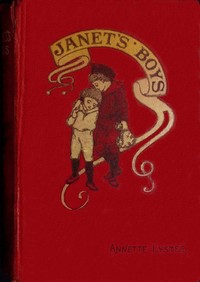
The catalog record for Janet's boys — Inside the Classic provides practical reading context through 40,589 words, 2 hr 57 min estimated reading time, and 5 detected text sections.
The text analysis averages about 16.2 words per sentence, while the detected sections provide another way to judge how the source is divided.
Project Gutenberg metadata also associates the work with “Didactic fiction,” connecting these edition facts with the source record’s subject description.
Explore this collection
These alternatives are selected using recorded categories and estimated reading time.
About 183 minutes
Historical Psychological Social Fiction
41,973 recorded words. 6 minutes difference from this book's estimate.
View Gutenberg source #74939About 197 minutes
Historical Psychological Social Fiction
45,147 recorded words. 20 minutes difference from this book's estimate.
View Gutenberg source #72157About 149 minutes
Historical Psychological Social Fiction
34,102 recorded words. 28 minutes difference from this book's estimate.
View Gutenberg source #75600Search stored excerpts and compare books → Choose by your preferences →
Choices use stored catalog measurements. Estimates vary with reading speed. A shared category is a catalog label, not a claim that two books have the same argument or literary quality.
Search reads excerpt text stored with this catalog and links to its associated Gutenberg record. The connection is stored in the site database; this tool does not recheck that every excerpt is word-for-word identical to that external record. Excerpt search does not cover every chapter and does not verify historical publication dates.
Catalog snapshot checked: 2026-09-25. Coverage: 98 public books, 98 available source excerpts.
Calculated from edition completeness, EPUB availability, text structure and catalogue metadata. Not a user rating.
Total of 100 points, scaled to a 2.5-5.0 range. Editions with an empty description or a missing EPUB file are not scored.
Public-domain source text
The source text is kept in the dedicated reader, separate from this catalogue record and its commentary.
The opening chapter of Janet's Boys establishes a deliberately flat, reportorial tone. Mr. Rayburn, a brewery manager, proposes remarrying not out of romance but because his house has lost its 'homelike look' since his wife's death. The narrator describes his first wife as 'quiet, docile,' with 'no idea beyond her simple round of womanly duties'—a phrasing that signals the novel's interest in practical, unromantic domestic arrangements. The prose is efficient, almost clinical, yet it accumulates small, telling details: the servant Judith resents the extra work caused by Fred's return, and the father 'had no idea how to manage the child.' This voice, plain but not artless, sets up a world where comfort is a matter of management rather than sentiment.
Lyster’s narrator rarely editorializes. When Mr. Rayburn chooses his first wife 'with a view to being made comfortable,' the observation is presented as fact, not criticism. The same detachment appears in the description of Judith Ames: she 'greatly resented the additional trouble' of Fred’s presence. The narrative voice is that of a cool observer, noting cause and effect without moralizing. This restraint extends to the boys’ disappearance. The search is described in procedural terms—'the ponds were searched,' 'long poles tipped with hooks'—and the narrator withholds interiority from the characters. Even Mrs. Rayburn’s terror is reported externally: she is 'wailing in a terrified manner.' The effect is a kind of documentary realism, where emotion is inferred from action rather than stated.
The early chapters move at the pace of daily life: meals, conversations, the slow erosion of comfort. But when the boys run away, the rhythm changes abruptly. The search scenes are taut, with short sentences and precise details: 'The Kelmer is full of deep holes, and is known as a river that seldom gives up a victim.' The narrator’s earlier detachment becomes almost ominous. Later, the discovery of the red bag 'with the word “Janet” worked on it in white' introduces a tangible clue, and the pace quickens again. Lyster uses these shifts to create suspense without melodrama. The contrast between the measured domestic opening and the urgent search sequences gives the novel an uneven but effective rhythm, mirroring the disruption of order by crisis.
Certain objects and phrases recur with quiet significance. The bag marked 'Janet' is first mentioned as the boys’ property, then found near the bridge—a concrete link between the missing children and their mother. The river Kelmer is described twice as a river that 'seldom gives up a victim,' a phrase that echoes through the search. The boys’ term for their mother, 'muddie,' appears in the bread-buying scene and in Frank’s message, creating a private language that contrasts with the formal adult world of 'Mrs. Rayburn' and 'my lord.' These details are not heavily symbolic; they function as anchors in a narrative that otherwise avoids ornament. Lyster trusts the reader to notice their recurrence, building meaning through repetition rather than explanation.
Readers attentive to narrative craft will find Janet's Boys an interesting study in restraint. Lyster’s plain style and preference for showing over telling create a story that feels both direct and deliberately understated. The shifts in pace—from domestic routine to search-and-discovery—are handled without fanfare, and the recurring motifs (the bag, the river, the word 'muddie') reward close attention. This is not a novel that announces its themes; it lets them emerge from the accumulation of concrete, unadorned detail.
In Janet's Boys, the Rayburn family’s grief is a quiet, constant presence, much like the unsettled loyalty that haunts John Marvel in The Splendid Spur Being Memoirs of the Adventures of Mr. John Marvel, a Servant of His Late Majesty King Charles I, in the Years 1642-3 — Story, Setting & Ideas. Both are stories of boys forced to grow up sideways, holding their true feelings close, the way we all do when the world asks for courage instead of tears.
A brief reflection can help important ideas stay with you longer.