About 113 minutes
Marigold's decision — Themes and Context
Fantasy Juvenile Worlds
25,842 recorded words. 1 minutes difference from this book's estimate.
View Gutenberg source #73955
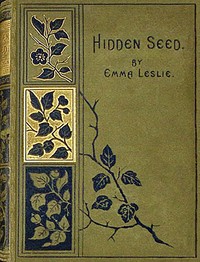
For Hidden seed — Text and Context, the stored edition analysis reports 26,087 words, 1 hr 54 min estimated reading time, and 3 detected text sections.
The text analysis averages about 18.2 words per sentence, while the detected sections provide another way to judge how the source is divided.
Project Gutenberg metadata also associates the work with “Christian life -- Juvenile fiction,” connecting these edition facts with the source record’s subject description.
Explore this collection
These alternatives are selected using recorded categories and estimated reading time.
About 113 minutes
Fantasy Juvenile Worlds
25,842 recorded words. 1 minutes difference from this book's estimate.
View Gutenberg source #73955About 112 minutes
Fantasy Juvenile Worlds
25,657 recorded words. 2 minutes difference from this book's estimate.
View Gutenberg source #72740About 103 minutes
Fantasy Juvenile Worlds
23,512 recorded words. 11 minutes difference from this book's estimate.
View Gutenberg source #73331Search stored excerpts and compare books → Choose by your preferences →
Choices use stored catalog measurements. Estimates vary with reading speed. A shared category is a catalog label, not a claim that two books have the same argument or literary quality.
Search reads excerpt text stored with this catalog and links to its associated Gutenberg record. The connection is stored in the site database; this tool does not recheck that every excerpt is word-for-word identical to that external record. Excerpt search does not cover every chapter and does not verify historical publication dates.
Catalog snapshot checked: 2026-09-25. Coverage: 98 public books, 98 available source excerpts.
Calculated from edition completeness, EPUB availability, text structure and catalogue metadata. Not a user rating.
Total of 100 points, scaled to a 2.5-5.0 range. Editions with an empty description or a missing EPUB file are not scored.
Public-domain source text
The source text is kept in the dedicated reader, separate from this catalogue record and its commentary.
On her fifteenth birthday, Mabel Randolph announces a resolution to become a missionary to the heathen, but her mother's summons to music practice immediately undercuts her declaration. The opening chapter establishes a pattern of interrupted intentions: Mabel's private aspirations clash with domestic obligations, and her newly granted garden-room—a space meant for focused study—becomes a retreat for self-centered brooding. Emma Leslie's narrative voice frequently steps in to comment on Mabel's inner state, as when she notes that Mabel 'was anything but happy under the influence of such feelings' after resolving to outperform her cousin Julia at a musical party. The story's tensions revolve around visible markers of status—a dress with an ink stain, a borrowed pattern, a rocking chair disguised with chintz—and the gap between Mabel's stated ideals and her actual behavior.
The ink-stained dress that opens the novel is more than a mishap; it signals Mabel's preoccupation with appearance and social standing. When her cousin Isabel urges her to order a dress like her own, Mabel yields without asking the cost, persuaded that 'she must have a new dress' and that the pretty fabric 'would certainly suit her.' Leslie underscores the moral weight of this choice by having Mabel later survey herself 'with no small complacency' before the party. The dress becomes a physical emblem of the worldliness she claims to despise. Earlier, Mabel had dismissed music and German as frivolous, yet she pours hours into practicing a sonata specifically to 'surprise and vex' her aunt and cousin. The narrative repeatedly shows her rationalizing her own vanity: she 'persuaded herself that she could not help it' and blamed others for her growing worldliness.
Mabel's garden-room is described as a refuge furnished with rescued lumber-room pieces, 'their defects cleverly hidden with chintz draperies.' Her mother intended it as a quiet study space, but Mabel sees it as a place to 'shut herself up and follow her own devices, apart from the rest of the family.' The room's dual nature—a collaborative project between mother and daughter versus a private fortress—mirrors Mabel's internal conflict. Her sister Mary calls it 'a den, or an old curiosity shop, or a lumber-room,' puncturing its pretensions. The room also becomes a site of exclusion: Mabel orders Mary out, asserting ownership. Leslie uses the setting to highlight how Mabel's desire for independence curdles into isolation and selfishness, a pattern that recurs when she later rebuffs her cousin Isabel's friendly overtures.
The musical party crystallizes the novel's central tensions. Mabel believes her piece was chosen deliberately to make her fail, and she is 'determined to defeat' her cousin Julia and 'wring a triumph out of this very disappointment.' Leslie's narrator observes that Mabel was 'anything but happy under the influence of such feelings.' In contrast, Isabel embodies self-forgetfulness: she 'could and did enjoy everything,' unaware of the 'envyings, and jealousies, and rivalries' around her. When Mabel finishes playing and sits down fuming, Isabel slips her hand into Mabel's and asks what is wrong, only to be met with a fierce retort. The scene exposes how Mabel's competitive drive poisons her relationships and her own enjoyment. The old woman's parable about the sower and the seed, which Mabel resists being reminded of, hangs over these events as an unheeded lesson about the condition of her heart.
Readers attentive to the novel's moral framework will notice how Leslie embeds religious instruction within everyday domestic friction. The parable of the sower, referenced in the chapter title 'The Sower and the Seed,' provides a lens for interpreting Mabel's choices: the seed of her missionary ambition falls among thorns of vanity and resentment. The excerpts offer no resolution, but they establish a pattern of self-deception that the full text likely traces toward a reckoning. Pay particular attention to how minor characters—Isabel's naive goodwill, Mary's bluntness, the old nurse's wisdom—serve as foils to Mabel's self-absorption.
There’s something tender about Mabel’s new dress—that ache between wanting to be good and wanting to be noticed. I found that same quiet tension again later, wandering through the gardens in Rose Cottage. Not the same story, exactly, but the same soft afternoon light on an old house, the same sense of a girl figuring out who she is when no one’s watching. Rose Cottage — Edition Insights
Use these questions to collect your thoughts before moving on.