About 252 minutes
Rocky Fork — Background and Themes
Historical Psychological Social Fiction
57,850 recorded words. 23 minutes difference from this book's estimate.
View Gutenberg source #76984
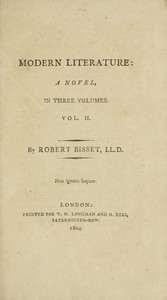
Before opening Modern literature: a novel, Volume 2 (of 3) — Reading Companion, the edition data offers a quick orientation: 52,574 words, 3 hr 49 min estimated reading time, and 14 detected text sections.
The text analysis averages about 25.3 words per sentence, while the detected sections provide another way to judge how the source is divided.
Project Gutenberg metadata also associates the work with “England -- Social life and customs -- 18th century -- Fiction,” connecting these edition facts with the source record’s subject description.
Explore this collection
These alternatives are selected using recorded categories and estimated reading time.
About 252 minutes
Historical Psychological Social Fiction
57,850 recorded words. 23 minutes difference from this book's estimate.
View Gutenberg source #76984About 256 minutes
Historical Psychological Social Fiction
58,775 recorded words. 27 minutes difference from this book's estimate.
View Gutenberg source #74791About 258 minutes
Historical Psychological Social Fiction
59,159 recorded words. 29 minutes difference from this book's estimate.
View Gutenberg source #332Search stored excerpts and compare books → Choose by your preferences →
Choices use stored catalog measurements. Estimates vary with reading speed. A shared category is a catalog label, not a claim that two books have the same argument or literary quality.
Search reads excerpt text stored with this catalog and links to its associated Gutenberg record. The connection is stored in the site database; this tool does not recheck that every excerpt is word-for-word identical to that external record. Excerpt search does not cover every chapter and does not verify historical publication dates.
Catalog snapshot checked: 2026-09-25. Coverage: 98 public books, 98 available source excerpts.
Calculated from edition completeness, EPUB availability, text structure and catalogue metadata. Not a user rating.
Total of 100 points, scaled to a 2.5-5.0 range. Editions with an empty description or a missing EPUB file are not scored.
Public-domain source text
The source text is kept in the dedicated reader, separate from this catalogue record and its commentary.
Robert Bisset opens Volume 2 with a detailed description of Brighton in the late eighteenth century, treating the town as a stage for social performance. The chapter catalogues the day's routines—bathing, breakfast, library visits, promenades on the Steyne—with the precision of a social observer. Bisset notes the 'spontaneous elocution of newspaper orators' and the 'spontaneous instructions of newspaper politicians,' capturing how public opinion was shaped in reading rooms. The narrative voice is analytical, often stepping back to comment on customs, as when he remarks on the 'anxiety greatest about Precedence, where there is none to settle.' This volume also introduces a central crisis: a false report of Hamilton's death triggers a chain of emotional and psychological reactions, revealing how rumor and misperception drive the plot.
Bisset devotes the opening chapter to a near-ethnographic account of Brighton's visitors and their pursuits. He lists 'chief ostensible pursuits' such as bathing, and proposes 'regulations suggested' for the practice, blending fiction with social commentary. The journal of a day structure—morning on the sea beach and cliffs, breakfast, libraries for London news—gives the novel a documentary quality. The narrator's eye lingers on the 'charming women' who 'resemble Venus in Beauty, and almost in its Display,' a remark that ties physical appearance to social display. The description of the Steyne as a 'rendezvous' and the mention of 'toys and dice' at the library underscore the leisure economy. Bisset even includes historical anecdotes, noting that Brighton was 'honoured by the Presence of Charles II' and 'not unworthy of that gallant Monarch,' linking contemporary manners to a royalist past.
The later excerpt shifts dramatically from social observation to psychological crisis. A servant's report that Hamilton is 'lying a corpse' sends Maria into a 'phrenzy of desperation,' vowing to 'follow him, and be buried in the same grave.' Bisset renders her collapse with clinical detail: 'fell lifeless on the ground,' then 'visions of despair.' Young Mortimer's reaction is equally intense: he imagines seeing Hamilton's ghost on the Downs, 'by the pale and twinkling light of the fading stars.' The narrative dwells on his internal debate about the possibility of disembodied spirits—'what was possible, though not probable, might exist'—before the figure speaks: 'Keep your distance, as you value your life.' The scene exploits the tension between rational piety and superstition, leaving Mortimer 'riveted to the spot' and later 'with his knees tottering, his face staring, wild, and bloodless.' The false alarm drives the plot through misunderstanding rather than action.
Throughout the excerpts, Bisset's narrator intrudes with judgments and asides. In the library scene, a 'governante complains of a milliner that had not kept her Distance,' illustrating anxieties about class boundaries. The narrator observes that 'anxiety greatest about Precedence, where there is none to settle,' a wry comment on the triviality of social competition. The character Scribble, introduced as 'a voluminous and noted author,' harangues the company, claiming to 'know every thing, and write on every Subject' while denying genius to others. This satirical portrait likely targets contemporary literary figures, though the excerpts do not name them. Bisset's style mixes formal diction with colloquial rhythms, as when Mortimer 'begged for his arm and assistance' from a watchman. The novel's structure—alternating between panoramic social description and intimate psychological drama—reflects its dual interest in external manners and internal states.
Readers should attend to how Bisset uses setting as a character: Brighton's geography—the sea, the Downs, the church—shapes both social routines and moments of crisis. The false-death plot, resolved only in part within these excerpts, hinges on characters' readiness to believe the worst, a pattern that may recur. The novel rewards attention to its digressions, such as the historical anecdotes about Charles II, which color the present with a sense of continuity. Bisset's irony is often dry; watch for the gap between what characters say and what the narrator implies.
I remember reading Bisset’s Brighton passages on a grey afternoon, feeling the weight of manners pressing down like sea-fog. It stirred something older—standing in my grandfather’s study, turning pages of The shooting party — Inside the Classic, where violence waits politely behind teacups. Both books hum with that quiet dread beneath decorum, a feeling I’ve never quite shaken.
Answer a few questions and save a private reflection on this device.